USAID DEC
The Jane Goodall Institute in Tanzania: Mainstreaming HIV Programming into Natural Resource Management and Economic Growth Activities
Sign inJOHN SNOW INTERNATIONAL
The Jane Goodall Institute in Tanzania: Mainstreaming HIV Programming into Natural Resource Management and Economic Growth Activities
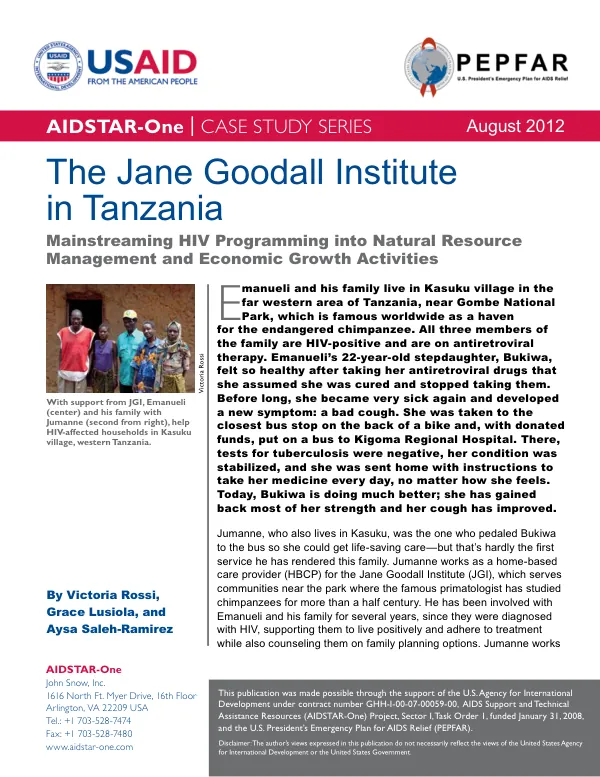
The Jane Goodall Institute in Tanzania has been working to address the impact of HIV on conservation and economic growth in the region.
2012 · 16 pages
Sign in to readA free account is required to download.
Abstract
The organization's community-centered model of conservation addresses local socioeconomic development needs, recognizing that environmental degradation is not the primary concern of local communities. Instead, health, education, safe water, and access to capital are community priorities. HIV has had a significant effect on conservation in sub-Saharan Africa, resulting in the loss of human capacity due to morbidity and mortality. National park and wildlife conservation staff are particularly vulnerable to HIV, leading to institutional memory loss and continuity of operations disruptions. Precious conservation funds are diverted to pay for HIV- and AIDS-related staff costs, and staff morale and productivity are negatively impacted. Increased use of natural resources is another strain on conservation, as HIV-affected households lose wage earners and capacity for heavy agricultural labor. Activities such as hunting, fishing, and charcoal making increase as families seek alternative livelihoods, leading to deforestation and environmental degradation. Traditional knowledge of sustainable natural resource management is also lost when parents die before passing it on to their children. The Jane Goodall Institute has been mainstreaming HIV programming into natural resource management and economic growth activities, supported by funding from a wraparound program between the PEPFAR-supported health team and the NRM/EG sector of USAID/Tanzania. This approach enables the organization to address the causes and effects of AIDS in an effective and sustained manner, both through their usual work and within their workplace. The organization's mainstreaming of HIV programming has been implemented through various projects, including the Lake Tanganyika Catchment, Reforestation and Education (TACARE) Project, which integrated the protection of high-value biodiversity and sustainable natural resource use through a community-centered conservation approach. The project was divided into five primary technical areas: community development, forestry, agriculture, health, and education. The TACARE Project supported community-run savings and credit programs, created village development funds, and promoted fuel-efficient stoves. It also set up tree nurseries, planted trees around villages, and established forestry reserves protected by village bylaws. The project developed and distributed improved palm seedlings, promoted cash crops, and trained in agro-forestry. Additionally, it established family planning, water, and environmental sanitation programs, and provided education and training to local communities. The Jane Goodall Institute's work in mainstreaming HIV programming into natural resource management and economic growth activities has been supported by funding from various sources, including the U.S. President's Emergency Plan for AIDS Relief (PEPFAR) and the Global Fund to Fight AIDS, Tuberculosis and Malaria. The organization's approach has been recognized as a model for addressing the impact of HIV on conservation and economic growth in the region.