INDONESIAN MINISTRY OF RESEARCH, TECHNOLOGY, AND HIGHER EDUCATION
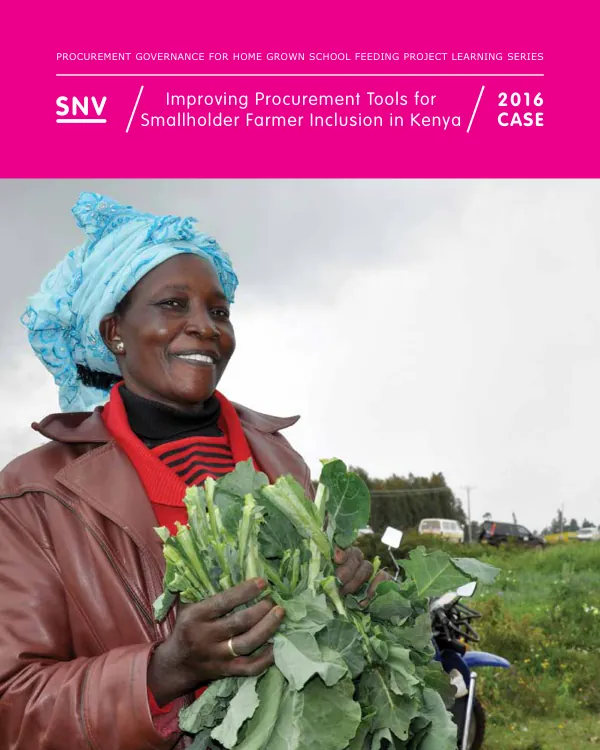
Improving Procurement Tools for Smallholder Farmer Inclusion in Kenya
The Kenya Home Grown School Meals Programme (HGSMP) is a national initiative that ensures over 761,000 school children in more than 2,100 primary schools receive a nutritious meal each school day.
2016 · 13 pages
Sign in to readA free account is required to download.
Abstract
The programme spends approximately $17 million USD per year on food, primarily purchasing maize and beans. The produce needed by each school is mainly sourced from smallholder farmers (SHFs), who are typically organized into producer organizations. However, baseline studies conducted by SNV under the Procurement Governance for Home Grown School Feeding (PG-HGSF) project found that Kenyan SHFs were not selling to schools participating in the national HGSMP as envisioned. Only 11% of the total foodstuffs purchased in the pilot areas were recorded as coming from smallholder farmers, mostly through traders. The SNV team concluded that the procurement process, particularly the procurement tools in use and Kenyan staff conducting the procurement, did not facilitate SHF inclusion as direct suppliers either through SHF producer organizations or indirectly through traders under Inclusive Business arrangements. A review of the procurement process identified several areas in which tools and staff training for procurement could be added or modified to make the process more responsive to the original intent of HGSMP. For example, explicit references to SHFs as preferred suppliers in the tender specification tools were omitted, and the same tools did not sufficiently address evaluation criteria that could lead to higher scores for SHFs or for traders providing evidence that they sourced from smallholders. Narok County, home to 102 schools with an enrollment of around 45,000 pupils, was selected as the pilot site for the procurement tool modification. The County has both pastoral and agricultural communities living in the Lower and the Upper zones respectively, with Narok North and South being food deficit areas. The School Meals Programme Committees (SMPCs) procure food three times per year, at the start of each school term, and are under strict instructions not to issue tenders for bids until the receipt of funds in their account for each term. The existing procurement tools were found to be deficient, as they restrict procurement to the time that funds are deposited in the schools' accounts, preventing schools from following a procurement plan when funds are delayed. Additionally, the tools do not facilitate outreach, engagement with, or inclusion of SHFs as suppliers, and the decision-making system is not sufficiently clear, coupled with inadequate record keeping, exposing the SMPC members to accusations of deception and lack of transparency. The SNV team proposed an intervention to pilot new and adjusted procurement instruments that could lead to greater inclusion of SHFs as suppliers to school feeding and facilitate the process at the school level. Four pilot schools were selected in Narok County: Nkinye, Nturumenti, Oloika, and Ntulele. The pilot had four objectives: to develop and test new procurement tools that facilitate SHF inclusion; to train SMPC members on the use of the new tools; to monitor and evaluate the effectiveness of the new tools in promoting SHF inclusion; and to document lessons learned and best practices for scaling up the intervention. The pilot aimed to address the challenges faced by both the target seller group (SHF producer organizations) and the schools, resulting in high levels of frustration, less than transparent processes, and uncertainty in achieving "best value" for the purchases and SHF involvement. The pilot was designed to test the effectiveness of new procurement tools in facilitating SHF inclusion and to identify areas for improvement in the existing procurement process.