USAID DEC
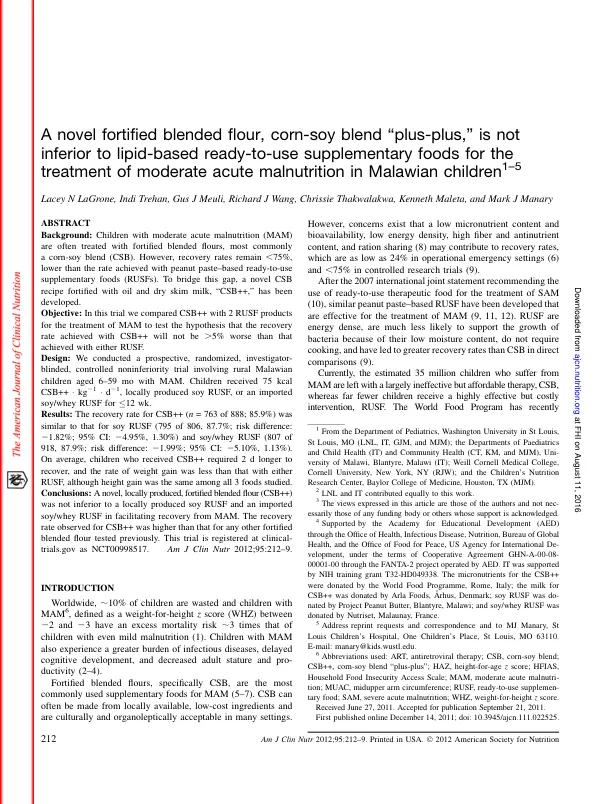
A Novel, Locally Produced, Fortified Blended Flour (CSB++) Was Not Inferior to a Locally Produced Soy RUSF and an Imported Soy/Whey RUSF in Facilitating Recovery from MAM
Sign inTHE WORLD FOOD PROGRAMME
A Novel, Locally Produced, Fortified Blended Flour (CSB++) Was Not Inferior to a Locally Produced Soy RUSF and an Imported Soy/Whey RUSF in Facilitating Recovery from MAM
Children with moderate acute malnutrition (MAM) are often treated with fortified blended flours, most commonly a corn-soy blend (CSB).
2012 · 8 pages
Sign in to readA free account is required to download.
Abstract
However, recovery rates remain lower than the rate achieved with peanut paste-based ready-to-use supplementary foods (RUSFs). To bridge this gap, a novel CSB recipe fortified with oil and dry skim milk, "CSB++," has been developed. The CSB++ recipe is designed for targeted therapy of children with MAM and for feeding vulnerable children 6 months to 2 years of age. In a prospective, randomized controlled clinical trial, CSB++ was compared with two RUSF products in the treatment of MAM. The trial was conducted in rural Malawi and involved 18 therapeutic feeding clinics. Children aged 6-59 months with MAM were recruited and excluded if they were simultaneously involved in another research trial or supplementary feeding program, had a chronic debilitating illness, or had a history of peanut allergy. The study design was a randomized, investigator-blinded, controlled clinical noninferiority trial that assessed the treatment of MAM with CSB++ for a period of 12 weeks, using the two RUSF products as active comparators. Children were defined as having recovered when they reached a weight-for-height z-score (WHZ) of -2. Children who received CSB++ had a recovery rate of 85.9%, which was similar to that for soy RUSF (87.7%) and soy/whey RUSF (87.9%). On average, children who received CSB++ required 2 days longer to recover, and the rate of weight gain was less than that with either RUSF, although height gain was the same among all three foods studied. The trial was approved by the College of Medicine Research and Ethics Committee at the University of Malawi and the Human Research Protection Office at Washington University in St Louis. The study was designed to detect a recovery rate difference of 5% between CSB++ and either RUSF, at a significance level of 0.05 with 80% power, assuming a recovery rate with RUSF of 85%. The planned sample size for the study was 900 children in each study arm. The trial was registered at clinicaltrials.gov as NCT00998517. The results of the trial suggest that CSB++ is not inferior to RUSF in facilitating recovery from MAM. The recovery rate observed for CSB++ was higher than that for any other fortified blended flour tested previously. The trial provides evidence that CSB++ can be an effective and affordable treatment for MAM in rural Malawi. The study's findings have implications for the treatment of MAM in other settings, particularly in areas where RUSF is not available or is too expensive. The trial's results also highlight the importance of considering the local context and cultural acceptability of food interventions. CSB++ was designed to be culturally and organoleptically acceptable in many settings, and its use in rural Malawi suggests that it can be an effective treatment for MAM in this context. The trial's findings also underscore the need for further research on the development and testing of affordable and effective treatments for MAM.