USAID DEC
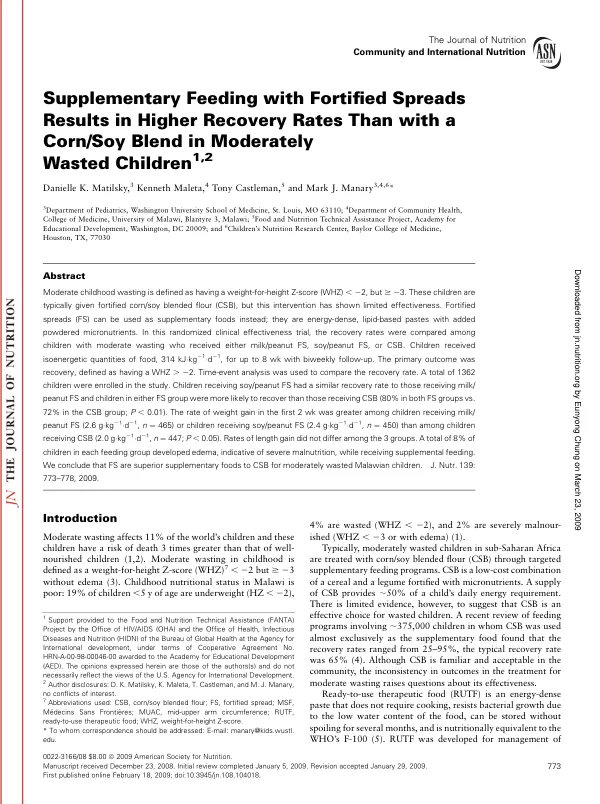
Supplementary Feeding with Fortified Spreads Results in Higher Recovery Rates Than with a Corn/Soy Blend in Moderately Wasted Children
Sign inACADEMY FOR EDUCATIONAL DEVELOPMENT
Supplementary Feeding with Fortified Spreads Results in Higher Recovery Rates Than with a Corn/Soy Blend in Moderately Wasted Children
Moderate childhood wasting affects 11% of the world's children, who have a risk of death three times greater than that of well-nourished children.
2009 · 6 pages
Sign in to readA free account is required to download.
Abstract
Moderate wasting in childhood is defined as a weight-for-height Z-score (WHZ) less than -2 but greater than -3 without edema. In Malawi, 19% of children under the age of 5 are underweight, 4% are wasted, and 2% are severely malnourished. Typically, moderately wasted children in sub-Saharan Africa are treated with corn/soy blended flour (CSB) through targeted supplementary feeding programs. CSB is a low-cost combination of a cereal and a legume fortified with micronutrients, providing approximately 50% of a child's daily energy requirement. However, there is limited evidence to suggest that CSB is an effective choice for wasted children. A recent review of feeding programs involving over 375,000 children found that the recovery rates ranged from 25-95%, with a typical recovery rate of 65%. This study aimed to determine the relative recovery and growth rates for moderately wasted children receiving either a soy/peanut fortified spread (FS), a milk/peanut FS, or CSB as a supplementary food. The study tested the hypothesis that children aged 6-60 months with moderate wasting receiving 314 kJ/kg/day of either milk/peanut FS or soy/peanut FS were more likely to recover during an 8-week intervention than children receiving an isoenenergetic ration of CSB. The study also tested the hypothesis that children receiving milk/peanut FS and soy/peanut FS were equally likely to recover. A total of 1362 children were enrolled in the study, which was conducted in 12 rural study sites in the southern region of Malawi. Children were randomly assigned to one of the three diets: milk/peanut FS, soy/peanut FS, or CSB. The primary outcome was recovery, defined as having a WHZ greater than or equal to -2. Secondary outcomes included the rates of gain in weight, stature, and mid-upper arm circumference (MUAC), and the development of adverse outcomes such as severe malnutrition or death. The results showed that children receiving soy/peanut FS had a similar recovery rate to those receiving milk/peanut FS, and children in either FS group were more likely to recover than those receiving CSB (80% in both FS groups vs. 72% in the CSB group; P < 0.01). The rate of weight gain in the first 2 weeks was greater among children receiving milk/peanut FS (2.6 g/kg/day, n = 465) or children receiving soy/peanut FS (2.4 g/kg/day, n = 450) than among children receiving CSB (2.0 g/kg/day, n = 447; P < 0.05). Rates of length gain did not differ among the three groups. A total of 8% of children in each feeding group developed edema, indicative of severe malnutrition, while receiving supplemental feeding. The study concluded that FS are superior supplementary foods to CSB for moderately wasted Malawian children. The results suggest that FS can be used as an effective alternative to CSB for the treatment of moderate childhood wasting, and that soy/peanut FS is a cost-effective option that can be used in place of milk/peanut FS.
Related documents
Documents in this collection
 2012
2012USAID DEC
A Novel, Locally Produced, Fortified Blended Flour (CSB++) Was Not Inferior to a Locally Produced Soy RUSF and an Imported Soy/Whey RUSF in Facilitating Recovery from MAM
Open record 2015
2015USAID DEC
Assessing the Feasibility of Using Eye Tracking to Study Infants' Cognitive Functioning in Rural Malawi
Open record