USAID
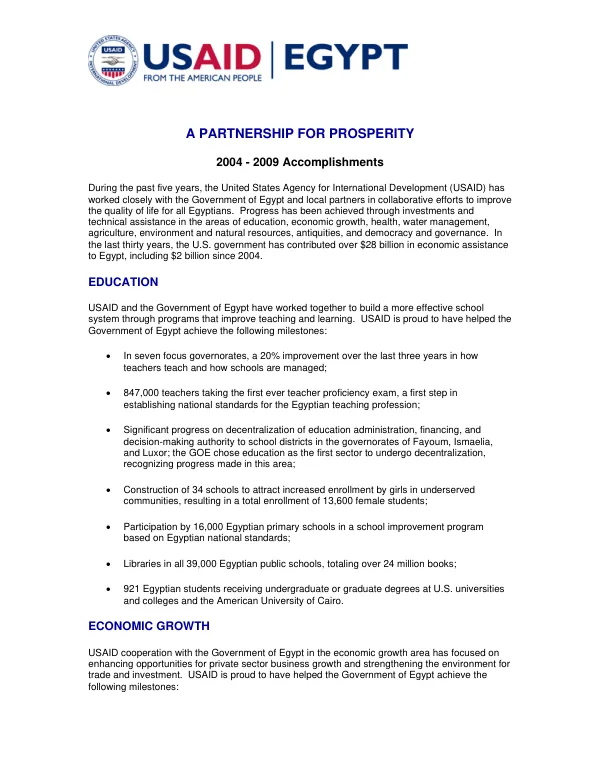
A PARTNERSHIP FOR PROSPERITY 2004 - 2009 Accomplishments
Over 2,500 farmers received training in sustainable agriculture techniques, with a focus on composting and crop rotation.
2009 · 6 pages
Sign in to readA free account is required to download.
Abstract
In Egypt, the United States Agency for International Development (USAID) has worked closely with the Government of Egypt and local partners to improve the quality of life for all Egyptians. Progress has been made through investments and technical assistance in education, economic growth, health, water management, environment, and natural resources, and democracy and governance. The U.S. government has contributed over $28 billion in economic assistance to Egypt since 2004. USAID and the Government of Egypt have worked together to improve the quality of education in Egypt. Programs have focused on improving teaching and learning, with a 20% improvement in teacher proficiency in seven focus governorates. The Government of Egypt has also achieved significant progress on decentralization of education administration, financing, and decision-making authority to school districts. Construction of 34 schools has attracted increased enrollment by girls in underserved communities, resulting in a total enrollment of 13,600 female students. USAID cooperation with the Government of Egypt in the area of economic growth has focused on enhancing opportunities for private sector business growth and strengthening the trade and investment environment. The establishment of the Consumer Protection Agency and the strengthening of intellectual property rights have contributed to a reduction in registration time for patents and a decrease in the number of decrees impeding business. The development of the mortgage market has resulted in the creation of ten mortgage finance companies, with LE 2.6 billion in mortgage loans issued. USAID has also worked with the Government of Egypt to improve health outcomes for underserved populations. Programs have focused on family planning and maternal care, with a 60% family planning use rate and a 14% increase in the number of women receiving regular prenatal care. The renovation of 246 health clinics has been coupled with community education and outreach, contributing to a 26% reduction in the infant mortality rate and a 31% reduction in the children under five mortality rate. In the area of potable water and sanitation, USAID has worked with the Government of Egypt to improve water-related programs. The installation of 160 kilometers of pipeline and the upgrade of seven water treatment plants have improved potable water service for over five million people. The construction of over 30 water and wastewater facilities has benefited more than three million people, while the expansion of the water collection and treatment system has improved the environment and health in Alexandria and the Mediterranean Sea. USAID cooperation with the Government of Egypt in the area of agriculture has focused on improving smallholder productivity and competitiveness in Upper Egypt. Programs have included the creation of more than 100 horticultural producer associations, with over 20,000 producers receiving training in new techniques. The development of an Egyptian Authority for Bio-Safety has allowed farmers to safely use and benefit from agricultural biotechnology. Integrated water management districts have been established to manage water resources more effectively, while the formation of 600 Water Users' Associations has allowed farmers to participate in the management of irrigation systems. USAID and the Government of Egypt have also worked together on environmental protection. The relocation of lead smelters away from residential areas has reduced lead pollution levels in densely populated areas. The introduction of cleaner fuels for local transit systems has reduced emissions, while the installation of mooring buoys has minimized damage to Egypt's Red Sea coral reef. Activities in Wadi El-Gemal National Park have protected the environment and promoted sustainable development.