USAID DEC
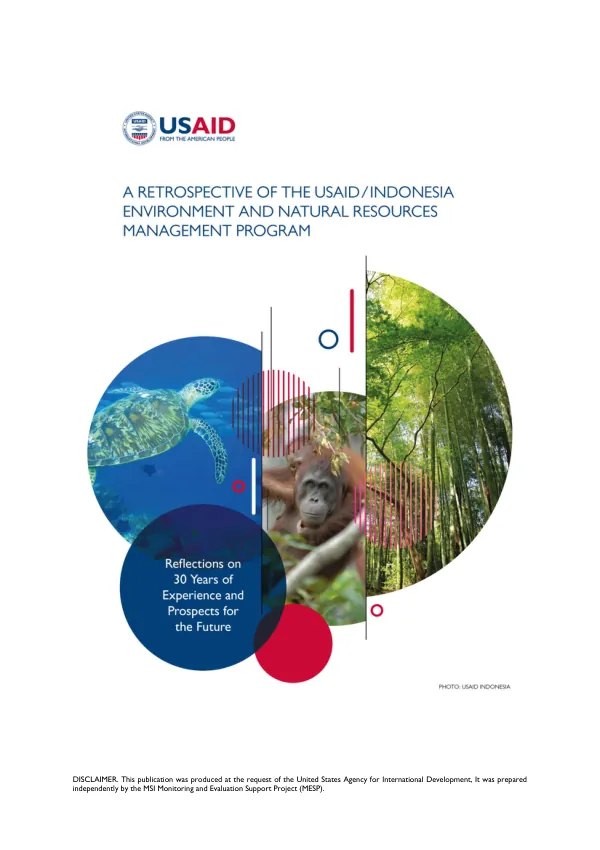
A Retrospective of the USAID/Indonesia Environment and Natural Resources Management Program
Sign inUSAID/INDONESIA/OPH
A Retrospective of the USAID/Indonesia Environment and Natural Resources Management Program
The USAID/Indonesia Environment and Natural Resources Management (NRM) Program began in 1990 with the goal of promoting sustainable natural resource management and conservation in Indonesia.
2019 · 122 pages
Sign in to readA free account is required to download.
Abstract
The program's historical context is rooted in Indonesia's post-colonial development, with the country transitioning from an authoritarian regime to a democratic government. This transition had significant implications for natural resource governance, with the government facing challenges in balancing economic development with environmental protection. The NRM Program's early years, from 1990 to 2005, were marked by authoritarian rule and the democratic transition. During this period, the program implemented several initiatives, including the Natural Resource Management Project I (NRMP I), which focused on policy reform and institutional development. NRMP I achieved several key successes, including the establishment of a national forest management plan and the development of a community-based natural resource management approach. However, the program also faced challenges, including limited community participation and inadequate institutional capacity. The NRM Program's strategy shifted in 2005, with a focus on decentralization and integrated site-based natural resource management. This shift was reflected in the Environmental Services Program (ESP), which aimed to promote sustainable forest management and biodiversity conservation. The ESP achieved several key successes, including the establishment of a national payment for ecosystem services scheme and the development of a community-based forest management approach. However, the program also faced challenges, including limited government support and inadequate community engagement. The NRM Program continued to evolve in the second 15-year period, from 2005 to 2020. During this time, the program implemented several new initiatives, including the Orangutan Conservation Services Project (OCSP) and the Indonesian Forestry and Climate Support Project (IFACS). The OCSP focused on orangutan conservation and community-based forest management, while the IFACS aimed to promote sustainable forest management and climate change mitigation. Both projects achieved several key successes, including the establishment of a national orangutan conservation plan and the development of a community-based forest management approach. The LESTARI Project, implemented from 2015 to 2020, built on the successes of previous initiatives and focused on sustainable natural resource management and climate change mitigation. The project achieved several key successes, including the establishment of a national sustainable forest management plan and the development of a community-based approach to natural resource management. The BIJAK Project, implemented from 2016 to 2021, focused on sustainable natural resource management and climate change mitigation in the marine sector. The project achieved several key successes, including the establishment of a national marine protected area network and the development of a community-based approach to marine conservation. The NRM Program's initiatives have had a significant impact on Indonesia's natural resource management and conservation efforts. The program's focus on community-based approaches, policy reform, and institutional development has helped to promote sustainable natural resource management and conservation in Indonesia. However, the program has also faced challenges, including limited government support and inadequate community engagement. Despite these challenges, the NRM Program has made significant contributions to Indonesia's natural resource management and conservation efforts, and its legacy will continue to shape the country's environmental policies and practices in the years to come.
Related documents
Documents in this collection
 2016
2016USAID DEC
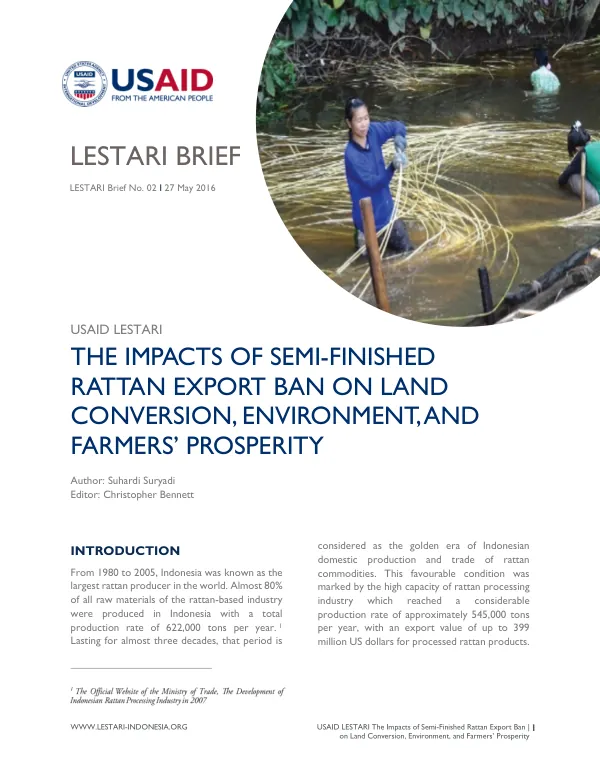
The Impacts of Semi-Finished Rattan Export Ban on Land Conversion, Environment, and Farmers’ Prosperity
Open record 2009
2009USAID DEC