BRIDGEBORN, INC.
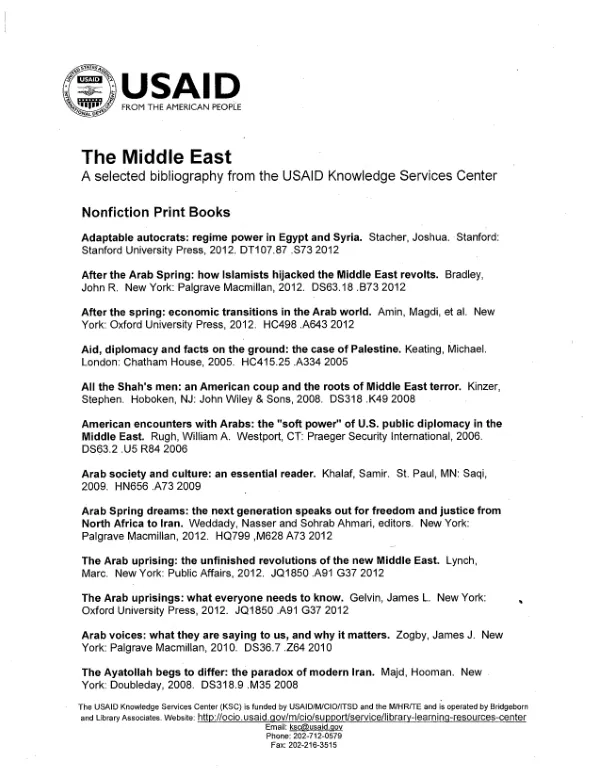
A selected bibliography from the USAID Knowledge Services Center
The Middle East is a region of significant geopolitical importance, with a complex history of conflict, cultural diversity, and economic development.
2014 · 13 pages
Sign in to readA free account is required to download.
Abstract
The region has been shaped by various factors, including colonialism, nationalism, and the rise of Islamist movements. The USAID Knowledge Services Center has compiled a selected bibliography of nonfiction print books on the Middle East, providing a comprehensive overview of the region's history, politics, culture, and economy. The bibliography includes works by prominent scholars and experts, such as Joshua Stacher, John R. Bradley, and Gilles Kepel, who have written extensively on the region's history, politics, and culture. The books cover a range of topics, including the Arab Spring, the Israeli-Palestinian conflict, and the rise of Islamist movements in the region. One of the key themes that emerges from the bibliography is the complex and often fraught relationship between the United States and the Middle East. Books such as Stephen Kinzer's "All the Shah's Men" and William A. Rugh's "American Encounters with Arabs" provide insight into the historical and cultural dynamics that have shaped this relationship. The bibliography also highlights the importance of understanding the cultural and social context of the Middle East. Books such as Asef Bayat's "Being Young and Muslim" and James J. Zogby's "Arab Voices" provide a nuanced and empathetic understanding of the experiences and perspectives of young people and ordinary citizens in the region. In addition to the historical and cultural context, the bibliography also covers the economic and development aspects of the Middle East. Books such as Khalid Sekkat's "Market Dynamics and Productivity Countries" and Ellysar Baroudy's "Managing Water Demand" provide insight into the economic challenges and opportunities facing the region. Overall, the USAID Knowledge Services Center's bibliography provides a comprehensive and nuanced understanding of the Middle East, highlighting the complex historical, cultural, and economic dynamics that shape the region. The bibliography is a valuable resource for policymakers, scholars, and anyone interested in understanding the complexities of the Middle East. The region's history is marked by periods of conflict and instability, including the Arab Spring, which began in 2010 and led to the overthrow of several authoritarian regimes. The Israeli-Palestinian conflict remains a major source of tension and instability in the region, with ongoing disputes over territory, borders, and the status of Jerusalem. The rise of Islamist movements in the region has also been a significant factor in shaping the Middle East's politics and culture. Books such as Gilles Kepel's "Beyond Terror and Martyrdom" and Asef Bayat's "Life as Politics" provide insight into the complexities of Islamist movements and their impact on the region. The economic challenges facing the Middle East are significant, with many countries struggling to develop their economies and provide for their citizens. Books such as Khalid Sekkat's "Market Dynamics and Productivity Countries" and Ellysar Baroudy's "Managing Water Demand" highlight the importance of economic development and good governance in addressing these challenges.