USAID
A Small Grant Solves A Big Water Problem
The Sino-Tibetan Plateau region of Tajikistan has faced significant challenges in accessing safe drinking water.
2018 · 2 pages
Sign in to readA free account is required to download.
Abstract
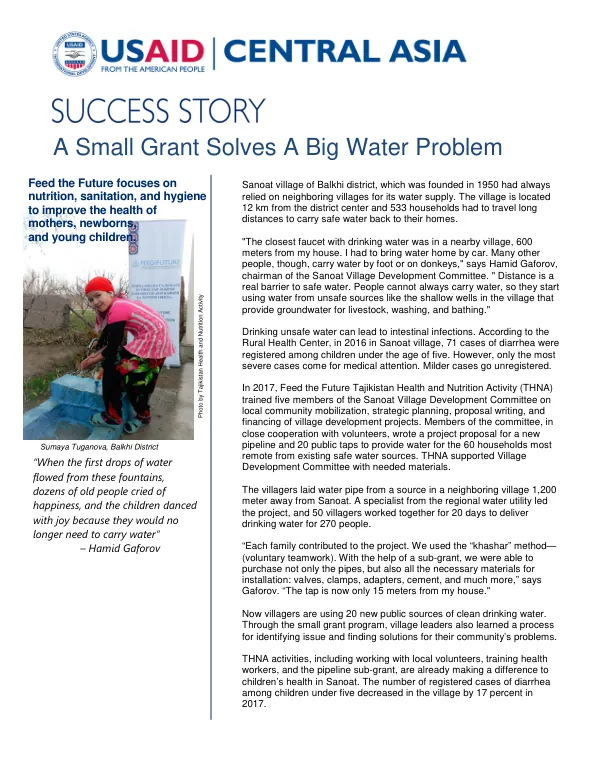
The village of Sinoat, founded in 1950, relied on neighboring villages for its water supply, resulting in long distances for residents to carry water. The village is located 12 kilometers from the district center, and 533 households had to travel to access safe water. The closest faucet with drinking water was in a nearby village, 600 meters from the homes of many residents. The chairman of the Sinoat Village Development Committee, Hamid Gaforov, stated that distance is a significant barrier to accessing safe water. Many residents carry water by foot or on donkeys, and some use water from shallow wells in the village that provide water for livestock, washing, and bathing. This practice can lead to the spread of waterborne diseases, such as diarrhea. In 2016, the Rural Health Center in Sinoat village reported 71 cases of diarrhea among children under the age of six. In 2017, the Feed the Future Tajikistan Health and Nutrition Activity (THNA) trained five members of the Sinoat Village Development Committee on local community mobilization, strategic planning, proposal writing, and financing of village development projects. The committee, in cooperation with volunteers, wrote a project proposal for a new pipeline and 20 public taps to provide water for the 60 households most remote from existing safe water sources. THNA supported the village development committee with necessary materials. The villagers laid a water pipe from a source in a neighboring village, 1,200 meters away from Sinoat. A specialist from the regional water utility led the project, and 50 villagers worked together for 20 days to install the pipeline. Each family contributed to the project, using the "khashar" method of voluntary teamwork. With the help of a sub-grant, the villagers were able to purchase the necessary materials, including pipes, valves, clamps, adapters, and adapters. The project resulted in the installation of 20 new public sources of drinking water in the village. The villagers are now able to access safe drinking water, and the village development committee has learned a process for identifying issues and finding solutions to their community's problems. The Feed the Future Tajikistan Health and Nutrition Activity has also made a significant impact on the health of children in the village. The number of registered cases of diarrhea among children under the age of five decreased by 17 percent in 2017.
Related documents