CHEMONICS
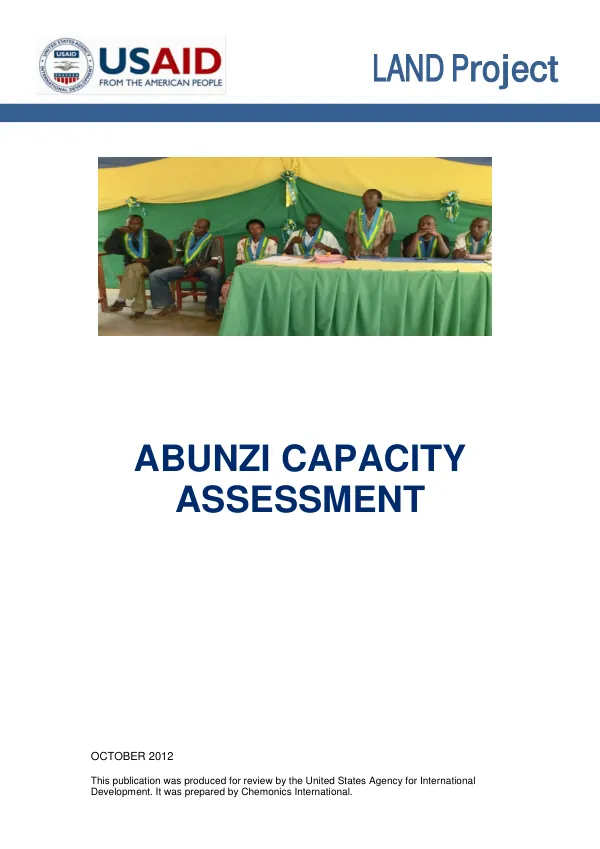
Abunzi Capacity Assessment
The Abunzi system in Rwanda is a local mediation committee that has been operating since 2006.
2012 · 74 pages
Sign in to readA free account is required to download.
Abstract
The system has been effective in resolving land disputes, with the Abunzi committees drawing on Rwandan laws and regulations to frame their decisions. However, the committees face several capacity challenges, including limited training and inadequate materials. A survey by Transparency International Rwanda highlighted the need for capacity building among the Abunzi committees. The creation of the Abunzi Secretariat in 2010 further emphasized the need for a comprehensive understanding of the capacity challenges faced by the Abunzi. This assessment aimed to address this need by assessing the extent to which the Abunzi committees are exercising their dispute resolution role, identifying enabling factors that contribute to their effectiveness, and identifying constraints that hinder their ability to exercise their mission. The assessment combined a desk review of pertinent literature and documents with administration of questionnaires, semi-structured interviews, focus group discussions, and observation. Interviews were conducted with government officials, technical staff of NGOs, and institutions involved in capacity building efforts targeting the Abunzi. A questionnaire was distributed to organizations that have engaged in capacity building efforts targeting the Abunzi, and a meeting was organized by the Abunzi Secretariat to share information and elaborate on their work. The assessment findings reveal that the Abunzi committees have several advantages, including being more affordable, accessible, participatory, and restorative compared to the ordinary court system. However, the committees face several challenges, including limited training and inadequate materials. The assessment proposes a strategy for comprehensively addressing the current and future capacity building needs of the Abunzi and the potential roles of different institutions in supporting this strategy. The Abunzi committees have been operating with little support and coordination since their inception in 2006. A survey by Transparency International Rwanda highlighted the need for capacity building among the Abunzi committees, and the creation of the Abunzi Secretariat in 2010 further emphasized the need for a comprehensive understanding of the capacity challenges faced by the Abunzi. The assessment aimed to address this need by assessing the capacity challenges faced by the Abunzi committees and proposing a strategy for addressing these challenges. The assessment findings reveal that the Abunzi committees face several capacity challenges, including limited training and inadequate materials. The committees also face challenges related to the law and procedure on Abunzi, including a lack of clarity on their roles and responsibilities. The assessment proposes a strategy for comprehensively addressing the current and future capacity building needs of the Abunzi and the potential roles of different institutions in supporting this strategy. The Abunzi committees have been effective in resolving land disputes, with the committees drawing on Rwandan laws and regulations to frame their decisions. However, the committees face several capacity challenges, including limited training and inadequate materials. The assessment proposes a strategy for comprehensively addressing the current and future capacity building needs of the Abunzi and the potential roles of different institutions in supporting this strategy.
Related documents
Documents in this collection
 2021
2021USAID DEC
Assessing and Strengthening Strategic Information Capacity of Local Partners Supporting USAID Missions to meet Journey to Self-Reliance goals
Open record 2015
2015USAID DEC