USAID DEC
Identifying common outcomes of CCB programs: key informant interviews with practitioners
Sign inUSAID DEC
Identifying common outcomes of CCB programs: key informant interviews with practitioners
The research project "Designing an evaluation methodology to assess capacity development for local innovation" aims to develop an integrated evaluation framework, methodology, and research protocols to assess changes in local innovation capacity at the grassroots level.
2021 · 11 pages
Sign in to readA free account is required to download.
Abstract
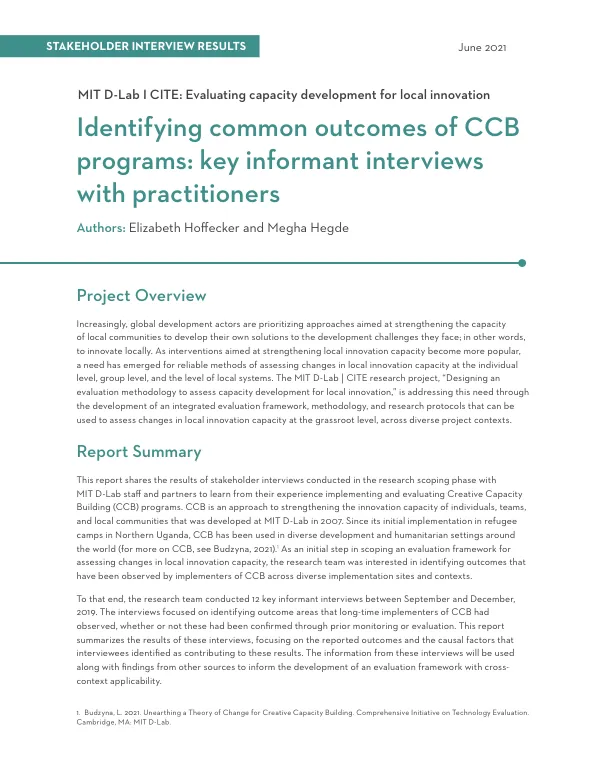
The project focuses on Creative Capacity Building (CCB) programs, an approach developed at MIT D-Lab in 2007 to strengthen the innovation capacity of individuals, teams, and local communities. The report shares the results of stakeholder interviews conducted in the research scoping phase with MIT D-Lab staff and partners to learn from their experience implementing and evaluating CCB programs. The interviews aimed to identify outcomes that have been observed by implementers of CCB across diverse implementation sites and contexts. The research team conducted 12 key informant interviews between September and December 2019, focusing on identifying outcome areas that long-time implementers of CCB had observed. The interviews revealed 26 types of outcomes associated with CCB, which were grouped into three categories: immediate, intermediate, and primary outcomes. Immediate outcomes, observed immediately following the CCB program's implementation, included changed mindsets and enhanced self-confidence at the individual level. Intermediate outcomes, observed in the time following the workshop, included participants changing their approach to their daily activities, improved social relations at the group level, and the creation of new projects at the community level. Primary outcomes, identified by three or more interviewees, included income generation for program participants at the individual level and improved gender relations at the group/team level. The contributing factors to these outcomes were identified at the level of codes using three categories: participant factors, program factors, and external factors. Participant factors included pre-existing attributes that cannot be influenced by the program, such as age and education level, as well as flexible factors that can be influenced by participation in the program, such as motivation and skills. Program factors included the design and implementation of the CCB program, including the training and support provided to participants. External factors included the local context in which the program was being implemented, including the social, economic, and cultural environment. The research team used a combination of etic codes, generated from pre-existing conceptual categories, and emic codes, generated from the language and experience of interviewees, to analyze the data. The data coding and analysis focused on two dimensions: the outcomes interviewees reported having observed in their experiences of implementing and/or evaluating CCB, and the factors that interviewees felt contributed to bringing about these outcomes. The findings from these interviews will be used along with findings from other sources to inform the development of an evaluation framework with cross-context applicability. The evaluation framework will aim to assess changes in local innovation capacity at the individual, group, and community levels, and will provide a comprehensive understanding of the outcomes and contributing factors associated with CCB programs.