USAID DEC
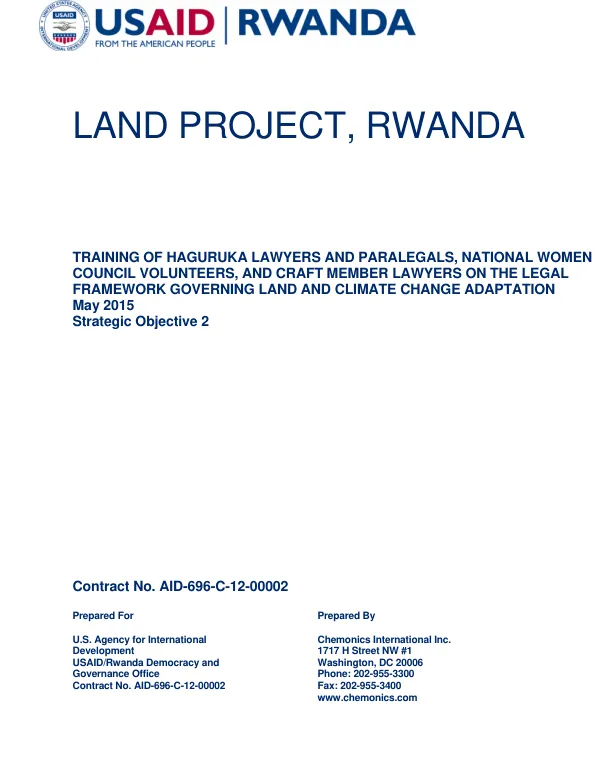
Training of Haguruka Lawyers and Paralegals, National Women Council Volunteers, and Craft Member Lawyers on the Legal Framework Governing Land and Climate Change Adaptation
Sign inCHEMONICS
Training of Haguruka Lawyers and Paralegals, National Women Council Volunteers, and Craft Member Lawyers on the Legal Framework Governing Land and Climate Change Adaptation
The training of HAGURUKA lawyers and paralegals, National Women Council volunteers, and CRAFT member lawyers on the legal framework governing land and climate change adaptation was conducted in May 2015.
2015 · 42 pages
Sign in to readA free account is required to download.
Abstract
The training aimed to enhance the knowledge and skills of these legal assistance providers on the new legal framework governing land and climate change risks and adaptation measures. The training was organized by the USAID LAND Project and HAGURUKA, a Rwandan non-profit legal entity established in 1991 with a mission of protecting and promoting the rights of women and children. HAGURUKA has a large network of legal aid providers helping to defend the rights of women and children in Rwandan communities, including their land rights. The training focused on the new law governing expropriation and on global climate change adaptation. Additionally, the course provided refresher training on key provisions of the 2013 Land Law, especially since many of its regulations are new and were not discussed in the 2013 training. The training included a special session for HAGURUKA lawyers and lawyers of other member organizations of the Rwandan Coalition for Women’s Access to Land (CRAFT). The main objectives of the training were to improve the understanding of HAGURUKA lawyers and paralegals, NWC volunteers, and CRAFT member lawyers on the legal framework governing land and land expropriation, to strengthen their ability to apply key elements of the law in the legal aid services they provide to communities, to equip them with knowledge and skills to boost community understanding of climate change phenomena, and to cultivate an in-depth understanding of the 2013 Land Law and its implementing regulations among HAGURUKA and CRAFT lawyers. The training was conducted in three districts: Rwamagana, Musanze, and Huye, and consisted of three training courses lasting two days each. The training was attended by HAGURUKA paralegals and NWC volunteers, as well as HAGURUKA lawyers and lawyers of other member organizations of CRAFT. The training evaluation revealed that the training was successful in achieving its objectives. The participants showed a significant increase in their understanding of laws governing land and strengthened their capacity to assist their clients in resolving land-related disputes. The training also enabled the participants to understand climate change, appreciate climate change vulnerabilities, and advise communities on simple measures they can adopt to enhance their resilience to the effects of climate change. The training was a collaborative effort between the USAID LAND Project and HAGURUKA, and it has significantly increased the understanding of laws governing land and strengthened the capacity of HAGURUKA lawyers and CRAFT member lawyers to assist their clients in resolving land-related disputes. The training has also contributed to the development of a more informed and resilient community in Rwanda. The training was conducted in a collaborative and participatory manner, with a focus on building the capacity of HAGURUKA lawyers and CRAFT member lawyers to provide effective legal aid services to communities. The training included a range of activities, including presentations, group discussions, and capacity assessments, which were designed to enhance the knowledge and skills of the participants. The training has contributed to the development of a more informed and resilient community in Rwanda, and it has also strengthened the capacity of HAGURUKA lawyers and CRAFT member lawyers to assist their clients in resolving land-related disputes. The training has also highlighted the importance of climate change adaptation and the need for communities to take simple measures to enhance their resilience to the effects of climate change. The training has also demonstrated the effectiveness of collaborative efforts between international organizations and local partners in building the capacity of legal assistance providers to provide effective legal aid services to communities. The training has also highlighted the importance of building the capacity of local partners to provide effective legal aid services to communities, and it has demonstrated the effectiveness of collaborative efforts in achieving this goal.
Related documents