HEALTH ALLIANCE INTERNATIONAL
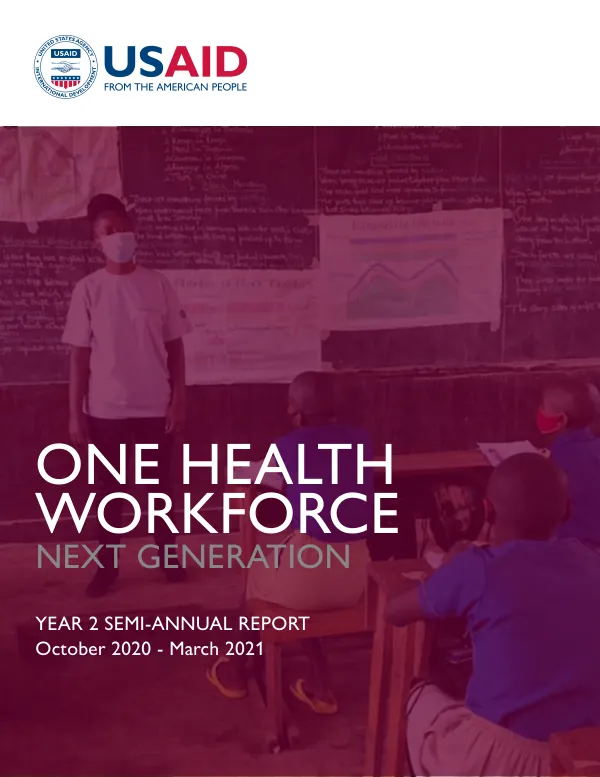
Semi-Annual Report 2020-2021: One Health Workforce-Next Generation
The One Health Workforce-Next Generation (OHW-NG) project is a collaborative effort between the USAID One Health Workforce – Next Generation Project and the One Health University Networks.
2021 · 208 pages
Sign in to readA free account is required to download.
Abstract
The project's primary goal is to empower One Health university networks to sustainably develop and deliver world-leading model programs for equipping professionals with transdisciplinary skills to address complex global health issues. The project's objective is to achieve three key outcomes: Training & Empowerment, Assessment & Tracking, and Organizational Sustainability. The Training & Empowerment objective focuses on providing training and capacity-building opportunities for One Health professionals, while the Assessment & Tracking objective involves monitoring and evaluating the project's progress and impact. The Organizational Sustainability objective aims to strengthen the organizational capacity of the One Health University Networks to promote sustainability. The project has made significant progress in achieving its objectives. The AFROHUN and SEAOHUN teams have demonstrated resilience and innovation in the face of the COVID-19 pandemic, utilizing virtual platforms to maintain momentum and working on various global health topics. The university students in One Health Innovation Clubs across Africa and Southeast Asia have also shown creativity and leadership in addressing the pandemic, identifying ways to stay connected and transferring COVID-19 technical knowledge into practical frameworks. The project has also made strides in strengthening its organizational capacity to promote sustainability. The OHW-NG Global Team provides support for all activities and includes diverse core partners such as the University of California (UC) Davis, UC Berkeley, UC Irvine, Columbia University ICAP Program, EcoHealth Alliance, University of New Mexico ECHO Institute, and Ata Health Strategies, as well as newer partners including Labyrinth Global Health, American Society for Microbiology, and ISID/ProMED. The project's performance data indicates significant progress in achieving its objectives. The AFROHUN Secretariat and Country Chapters have made notable contributions to the project's success, while the SEAOHUN Secretariat and OHUNS have also demonstrated strong performance. The project's Knowledge Management & Learning Plan, Transition Plan, Business Plan, Monitoring, Evaluation, & Learning Plan, and Gender Action Plan have all been updated to reflect the project's progress and goals. The project's global reach and impact are evident in its performance data, which highlights the significant contributions of the One Health University Networks in addressing complex global health issues. The project's success is a testament to the power of collaboration and innovation in addressing global health challenges, and it serves as a model for future initiatives in the field of One Health.
Related documents