CHEMONICS
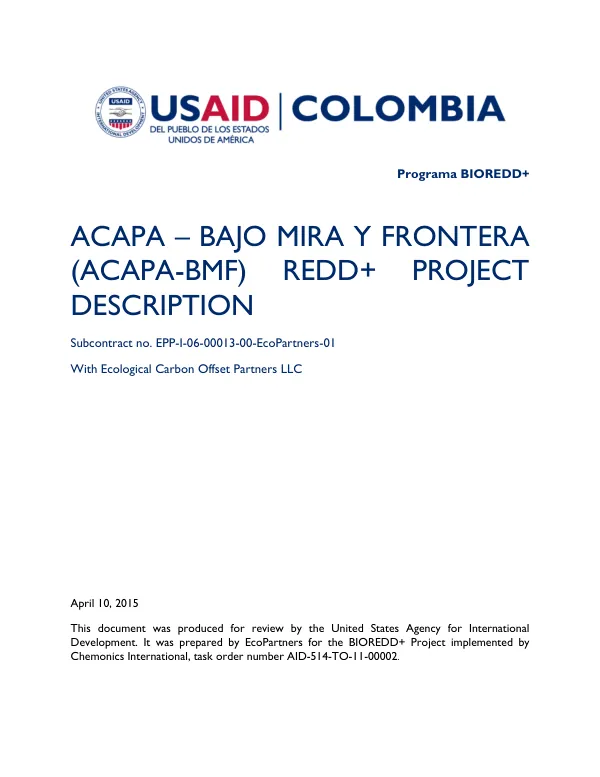
ACAPA – Bajo Mira y Frontera (ACAPA-BMF) REDD+ Project
The ACAPA – Bajo Mira y Frontera (ACAPA-BMF) REDD+ Project is a forest conservation initiative located in the Department of Nariño, Colombia.
2015 · 288 pages
Sign in to readA free account is required to download.
Abstract
The project aims to mitigate climate change by reducing deforestation and forest degradation, and promoting the natural recuperation of already degraded forest lands. Additionally, the project seeks to contribute to biodiversity conservation, including High Conservation Values, and foster sustainable development of local communities. The project objectives are threefold: (i) to mitigate climate change by reducing deforestation and forest degradation, and natural recuperation of already degraded forest lands; (ii) contribute to biodiversity conservation including High Conservation Values, and, (iii) foster sustainable development of local communities. The project will work to enhance the livelihoods of particularly vulnerable groups within communities and the communities themselves. The project is implemented by Consejo Comunitarios de ACAPA and Consejo Comuntario de Bajo Mira y Frontera, with Ecological Carbon Offsets Partners, LLC (ecoPartners) serving as the project developer. The project start date is November 13, 2013, and the GHG crediting period and project lifetime span from November 13, 2013, to November 12, 2043. The project implementation period and GHG monitoring period are not applicable for validation. The project area covers a total of 12,000 hectares, with the project zone located in the Department of Nariño, Colombia. The project location is characterized by a mix of tropical rainforest and cloud forest ecosystems, with a high level of biodiversity. The project area is also home to several indigenous communities, including the Nariño and Pasto communities. The project will implement a range of activities to achieve its objectives, including reforestation, forest restoration, and sustainable forest management. The project will also establish a system for monitoring and verifying the carbon credits generated by the project. The project is expected to generate significant carbon credits, which will be sold on the voluntary carbon market to support the project's activities. The project has undergone initial validation and is currently seeking full validation. The project's validation status is undergoing initial validation, with a validation report expected to be completed in January 2016. The project's CCB status history indicates that it is undergoing initial validation, with a CCB benefits summary outlining the project's objectives and expected outcomes.