USAID DEC
USAID helps to unlock Colombia’s nature tourism potential in a post COVID-19 reality
Sign inCHEMONICS
USAID helps to unlock Colombia’s nature tourism potential in a post COVID-19 reality
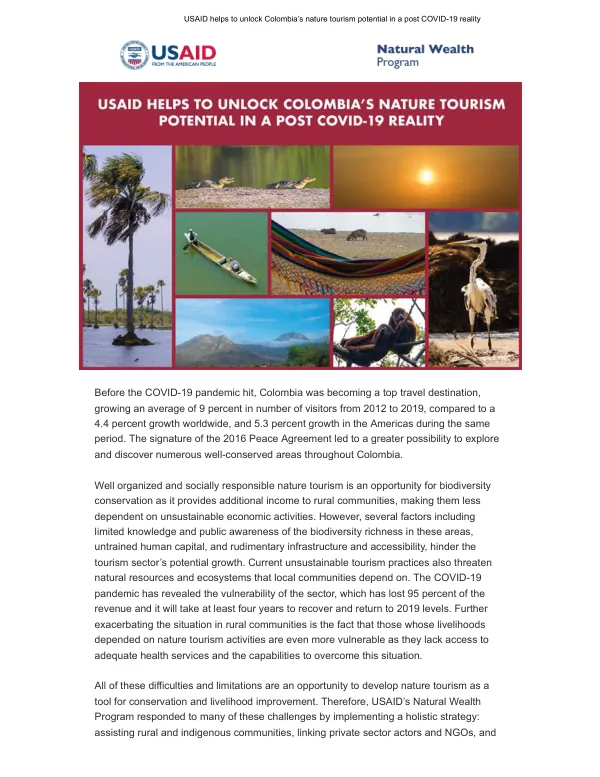
Colombia's nature tourism potential has been hindered by limited knowledge and public awareness of the country's biodiversity richness, untrained human capital, and rudimentary infrastructure and accessibility.
2020 · 4 pages
Sign in to readA free account is required to download.
Abstract
The COVID-19 pandemic has revealed the vulnerability of the sector, which has lost 95 percent of its revenue and will take at least four years to recover and return to 2019 levels. Rural communities, whose livelihoods depended on nature tourism activities, are particularly vulnerable due to lack of access to adequate health services and capabilities to overcome the situation. The USAID Natural Wealth Program has implemented a holistic strategy to address these challenges and develop nature tourism as a tool for conservation and livelihood improvement. The program assists rural and indigenous communities, links private sector actors and NGOs, and works with the Government of Colombia to bolster nature tourism as an opportunity to achieve self-reliance in the territories and conserve the country's rich biodiversity. The strategy addresses specific challenges facing nature tourism through six pillars. Public awareness is a key challenge, as rural communities lack environmental awareness of their territories, resulting in missed opportunities to conserve their natural wealth. The program has engaged more than 800 students and 25 educational and grassroots organizations to foster conservation of the tropical dry forest and the flooded savannas for future generations. Additionally, the program has implemented monitoring strategies alongside communities and NGOs, involving camera trapping activities, which have obtained more than 165,000 photos and videos, including 39 species in Montes de María and 31 in Orinoquía. Training is another critical pillar, as the program works with local organizations, providers, and the Government of Colombia to train young women and men in hospitality and tourism management, ecotourism, English as a second language, and entrepreneurial skills. The program has built more than 70 travel packages and trained more than 100 people through conservation and tourism workshops in the program's target landscapes. Capacity building is also essential, as the program works with local organizations, providers, and the Government of Colombia to train tourism providers, structure tourism destinations, and strengthen small organizations to provide small-scale ecotourism services. Links to markets are also crucial, as the program connects destinations with travelers both domestically and internationally through Awake Travel, a Colombian online nature tourism marketplace. The program is also working with NGOs to use digital tools and social media to market their services. Finally, the program is supporting ProColombia to host the 2020 Nature Travel Mart to promote Colombian destinations within international markets. The program is also working with the Government of Colombia to strengthen the nature tourism sector, supporting the legal framework review to acquire nature tourism guide licenses, participating in the development of the national tourism guiding school, and developing the National Handbook for Nature Tourism Guides. Additionally, the program has launched the Colombia Natural Wealth Award, a contest calling for proposals from every sector with the best initiatives to help transform the sector with innovative approaches to promote ecosystem conservation. To date, the contest has received more than 1,000 proposals from across the country. Overall, the USAID Natural Wealth Program's nature tourism strategy provides a roadmap to achieve lasting conservation efforts and provide economic alternatives for rural communities. With this effort, the program aims to propel once again Colombia's rich biodiversity as a means for sustainable development.