CHEMONICS
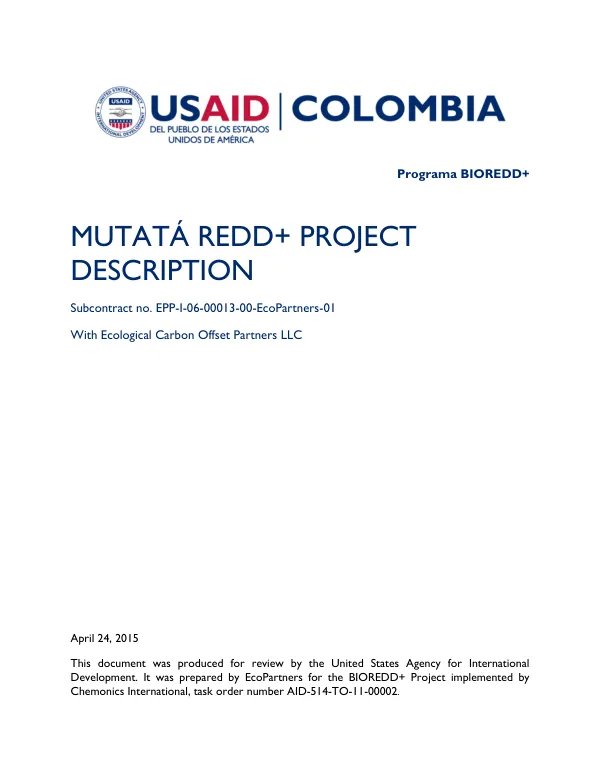
Mutatá REDD+ Project
The Mutatá REDD+ Project is a forest conservation initiative located in the departments of Antioquia and Chocó, Colombia.
2015 · 288 pages
Sign in to readA free account is required to download.
Abstract
The project aims to mitigate climate change by reducing deforestation and forest degradation, and promoting natural recuperation of already degraded forest lands. The project also seeks to contribute to biodiversity conservation, including High Conservation Values, and foster sustainable development of local communities. The project objectives are threefold: to mitigate climate change, contribute to biodiversity conservation, and foster sustainable development of local communities. The project will work to enhance the livelihoods of particularly vulnerable groups within communities and the communities themselves. The project start date is June 26, 2013, and the GHG crediting period and project lifetime is from June 26, 2013, to June 25, 2043. The project location spans across the departments of Antioquia and Chocó, covering a total area of approximately 25,000 hectares. The project area is characterized by a mix of tropical rainforest and cloud forest ecosystems, with a high level of biodiversity. The project zone is divided into three sub-zones, each with its unique ecological and social characteristics. Prior to project initiation, the project area was characterized by high levels of deforestation and forest degradation, with significant losses of carbon stocks and biodiversity. The project area was also home to several indigenous communities, who have traditional rights to the land and resources. The project proponent, the Cabildo Mayor Indígena de Mutatá, is a local indigenous organization that has been working to protect the rights of indigenous communities and promote sustainable development in the region. The project implementation period and GHG monitoring period is not applicable for validation, as the project is still undergoing initial validation. The project is seeking full validation under the Verified Carbon Standard (VCS) and the Climate, Community, and Biodiversity (CCB) standards. The project is expected to undergo verification in January 2016 and annually thereafter. The project design is based on a sectoral scope and project type, which includes a grouped project with multiple project activities. The project activities include reforestation, forest restoration, and sustainable forest management. The project technologies include the use of native tree species, agroforestry practices, and community-led forest management. The project climate impacts are expected to be significant, with estimated reductions in greenhouse gas emissions of up to 1.5 million tons of CO2 equivalent per year. The project will also contribute to biodiversity conservation, including the protection of High Conservation Values. The project will work to enhance the livelihoods of particularly vulnerable groups within communities and the communities themselves, through the provision of training and capacity-building programs. The project will also promote sustainable development of local communities, through the establishment of community-led forest management and sustainable forest products enterprises.
Related documents