USAID DEC
Accelerating Recovery and Resilience in South Sudan (ACCESS) FY21 – Annual Results Report
Sign inWORLD VISION
Accelerating Recovery and Resilience in South Sudan (ACCESS) FY21 – Annual Results Report
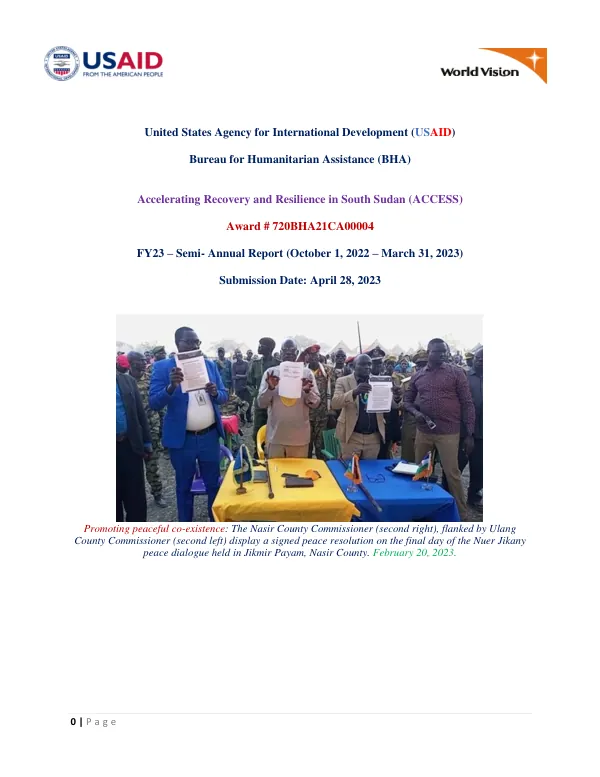
Accelerating Recovery and Resilience in South Sudan (ACCESS) is a Multi-Year Emergency Food Security Program implemented by World Vision with funding from USAID/BHA in the Upper-Nile State.
2021 · 24 pages
Sign in to readA free account is required to download.
Abstract
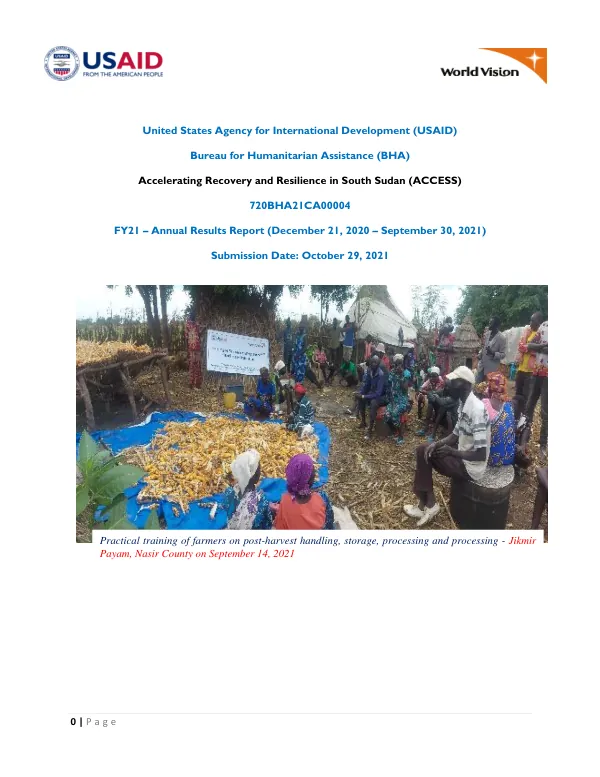
The program aims to assist vulnerable communities to promote and buttress their resilience to acute shocks and chronic stresses by building their absorptive, adaptive, and transformative capacities. The project targets 25,198 vulnerable households (about 151,188 individuals) across 23 Payams from the four counties of Melut, Baliet, Ulang, and Nasir. The 36 months' assistance commenced on December 21, 2020, and will be implemented until December 14, 2023. The project purposes/objectives are to strengthen household livelihoods, agricultural productivity, and nutrition; strengthen community cohesion through improved disaster risk management, protection, mental health and psycho-social support (MHPSS) services, and strengthen coordination, systems, and learning on recovery and resilience. The main sectors of intervention are Food Security and Livelihoods; Protection and Gender Based Violence; Mental Health and Psychosocial Support; Disaster Risk Reduction and Water, Sanitation and Hygiene. The activities being undertaken in these sectors include provision of trauma-sensitive response services for gender-based violence, establishing and strengthening community capacity to identify, report, and respond to early warning identifiers, increasing household access to diversified livelihood inputs, and promoting post-harvest handling, processing, and storage practices at individual and community levels. The project has enabled participant households to develop the capacity to withstand shocks by providing broad-based trainings on a variety of skills related to agriculture, livelihoods diversification, Disaster Risk Reduction (DRR), GBV, Protection, Peace Building, Mental Health and Psychosocial Support (MHPSS), Nutrition, Small Scale Business, and WASH. Field demonstration sites for Farmer Field Schools and seed multiplication gardens serving as practical knowledge generation and assimilation points were established to augment farmers' knowledge and skills. The project's goal is to accelerate recovery and bolster resilience by providing essential complementary services that leverage existing World Food Programme (WFP), Food and Agriculture Organization (FAO), UNICEF, and other USAID humanitarian assistance. The project's activities are being implemented simultaneously in partnership with two local sub-grantees, namely Nile Hope and Humanitarian & Development Consortium, across all the targeted Payams to help achieve the project objectives. South Sudan continues to grapple with numerous challenges, including a precarious food security situation with an estimated 6.6 million people requiring life-saving assistance and protection. The country's 2021 Humanitarian Response Plan identified 8.3 million people as being in urgent need of humanitarian assistance, including refugees, spread across the country. This is an 800,000-person increase in absolute numbers from the 7.5 million people who were in need in 2020. The humanitarian needs in South Sudan remain fluid due to persisting pockets of conflicts in many parts of the country, including defections amongst SPLA/IO factions in Upper Nile State. The impacts of COVID-19 on markets and mobility coupled with the current widespread floods have only served to exacerbate the plight of the nation with recovery far from being a reality. In response to the prolonged humanitarian crisis in the country, World Vision is implementing the ACCESS project to assist vulnerable communities to promote and buttress their resilience to acute shocks and chronic stresses by building their absorptive, adaptive, and transformative capacities.