FOOD AND AGRICULTURAL ORGANIZATION
FY21 Q3 Report: Accelerating Recovery and Resilience in South Sudan (ACCESS)
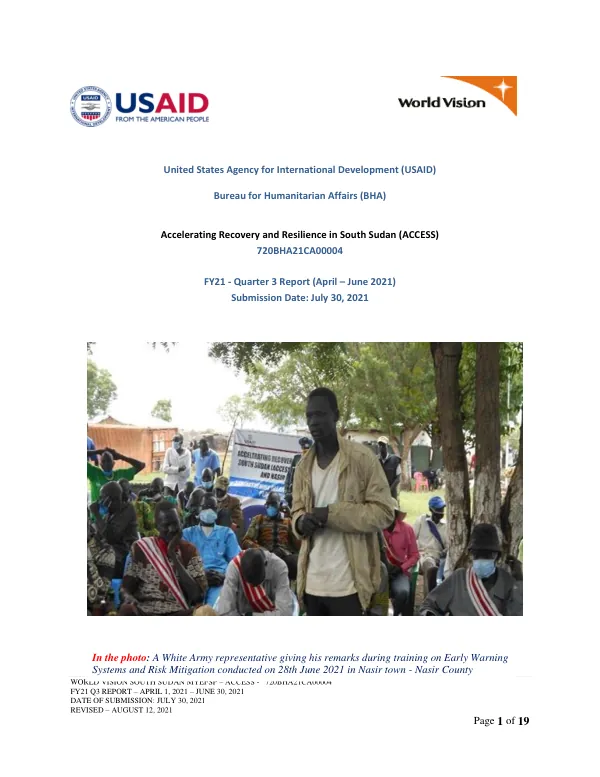
The Accelerating Recovery and Resilience in South Sudan (ACCESS) project, implemented by World Vision in Upper Nile State, aims to address the impacts of the prolonged humanitarian crisis in the country.
2021 · 19 pages
Sign in to readA free account is required to download.
Abstract
The project targets 25,198 vulnerable households with approximately 151,188 individuals across 28 Payams in the five counties of Melut, Nasir, Baliet, Ulang, and Renk. The 36-month assistance commenced on December 15, 2020, and will be implemented until December 14, 2023. During the reporting quarter, the project made significant progress in staff recruitment and deployment, which was crucial for the implementation of planned activities. The completion of the participants' selection process in Baliet and Melut counties enabled the commencement of several activities with accelerated speed. However, the persistent incidences of inter-communal violence and pockets of insecurity in some project locations remain an obstacle to the execution of some activities. The ACCESS Project Baseline Report was submitted and approved by BHA on May 20, 2021. Additionally, key M&E documents, including the Revised Logframe, Revised Monitoring and Evaluation Plan, Performance Indicator Reference Sheet (PIRS), and Indicator Performance Tracking Table (IPTT), were submitted and subsequently approved by USAID/BHA. Upper Nile State experienced higher temperatures during the reporting quarter, ranging between 104-109°F. However, in mid-May, the state started experiencing cloud covers, followed by slight rainfall towards the end of the month. Throughout June, the state registered progressively heavy but erratic rainfall, causing accessibility challenges to locations in Ulang, Baliet, and Melut counties, thereby affecting the smooth implementation of project activities. The heavy rains are predicted to persist, with potential to cause flooding and reduced crop yield performances. The country is currently facing its highest levels of food insecurity and malnutrition since independence 10 years ago. The latest food security analysis estimates that the 2021 lean season, between April and July, will be the worst ever in terms of severity, with 108,000 people in catastrophe (IPC Phase 5). The prices of commodities in major towns such as Malakal and Renk in Upper Nile have persistently remained high, with a 50-kilogram bag of sorghum grains selling at 15,000 SSP (i.e., USD 76.8) and 25,000 SSP (i.e., USD 128) in Renk and Malakal, respectively. The FOREX rate remained relatively consistent with the national rate during the reporting period. The project's goal is to accelerate recovery and bolster resilience by providing essential complementary services that leverage existing World Food Programme (WFP), Food and Agriculture Organization (FAO), UNICEF, and other USAID humanitarian assistance programming. The project's implementation is hindered by the persistent incidences of inter-communal violence and pockets of insecurity in some project locations. The project's implementation is also affected by the heavy rains experienced in Upper Nile State, which have caused accessibility challenges to locations in Ulang, Baliet, and Melut counties. The heavy rains are predicted to persist, with potential to cause flooding and reduced crop yield performances. The project's goal is to accelerate recovery and bolster resilience by providing essential complementary services that leverage existing WFP, FAO, UNICEF, and other USAID humanitarian assistance programming.