USAID DEC
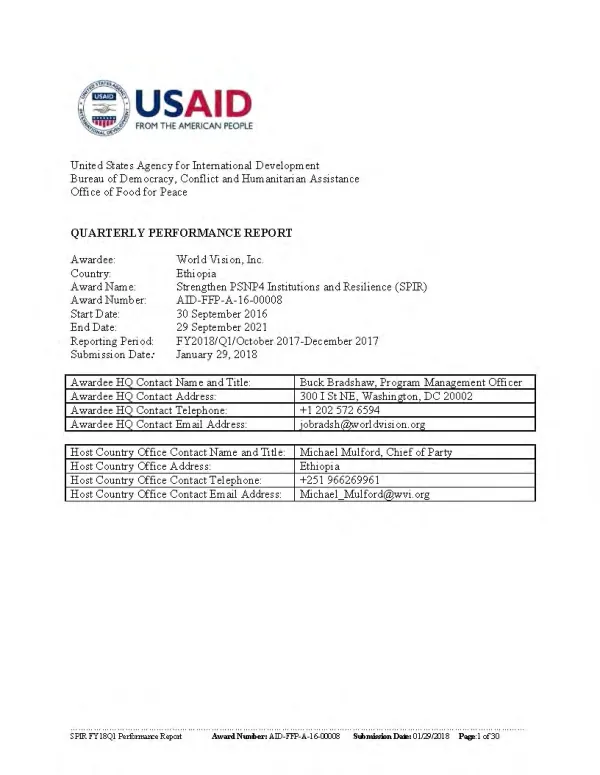
Quarterly Performance Report: Strengthen PSNP4 Institutions and Resilience (SPIR) FY18Q1
Sign inCARE
Quarterly Performance Report: Strengthen PSNP4 Institutions and Resilience (SPIR) FY18Q1
The Strengthen PSNP4 Institutions and Resilience (SPIR) Development Food Security Activity (DFSA) implemented by World Vision, CARE, and ORDA aims to enhance livelihoods, increase resilience to shocks, and improve food security and nutrition for rural households vulnerable to food insecurity in Ethiopia.
2018 · 30 pages
Sign in to readA free account is required to download.
Abstract
SPIR is responsive to community needs, carefully aligned with the Productive Safety Net Program (PSNP) and grounded in the depth of experience of its consortium partners. The project focuses on institutional strengthening of the PSNP, especially at the Woreda and Kebele-levels. In Amhara, below normal rainfall during the Belg rainy season resulted in poor crop production, and Bugna, Meket, Dahina, Sekota, and Gaz Gibla were designated as Priority 1 hotspot woredas. As a result, these areas were targeted for two extra rounds of support for PSNP and other targeted beneficiaries. Following the Meher season harvest during this period, most farmers in the woredas have sufficient staple grains to meet daily food needs. The food security and nutrition situation in the SPIR implementation woredas of Amhara (Bugna, Lasta, Wadla, Meket, Sekota, Dahena, and Gaz Gibla) is typical of an average harvest agricultural season. The project operates in 8 Woredas in Amhara region, 6 Woredas in Oromia region, and 2 Woredas in SNNPR region, with a total of 526,444 vulnerable target coverage. The project has four main purposes: increased income, productive assets, and equitable access to nutritious food for vulnerable women, men, and youth; improved nutritional status of children under 2, pregnant and lactating women, and adolescent girls; increased women's empowerment, youth empowerment, and gender equity; and strengthened ability of women, men, and communities to mitigate, adapt to, and recover from human-caused and natural shocks and stresses. The project has seven project elements: agriculture and livelihoods interventions, capacity building, maternal and child health, nutrition, social assistance, income-generating activities, and water supply and sanitation. World Vision is the consortium lead, responsible for overall project leadership and management, while CARE is responsible for technical leadership in agricultural livelihoods and gender mainstreaming. ORDA supports the consortium in providing government partnership consultation and support, and is responsible for technical leadership in disaster risk management and natural resource management areas. In the first quarter of FY18, the project made significant progress in Amhara and Oromia region intervention woredas, as well as in the pilot project implemented in SNNP Region. The project has engaged over 526,444 project participants, with 262,437 women, men, and youth farmers benefiting from agriculture and livelihoods interventions. The project has also implemented climate change and building resilience to disaster risk through capacity building and preparedness planning activities, with 147,978 project participants engaged in these activities.
Related documents