USAID. MISSION TO CAMEROON
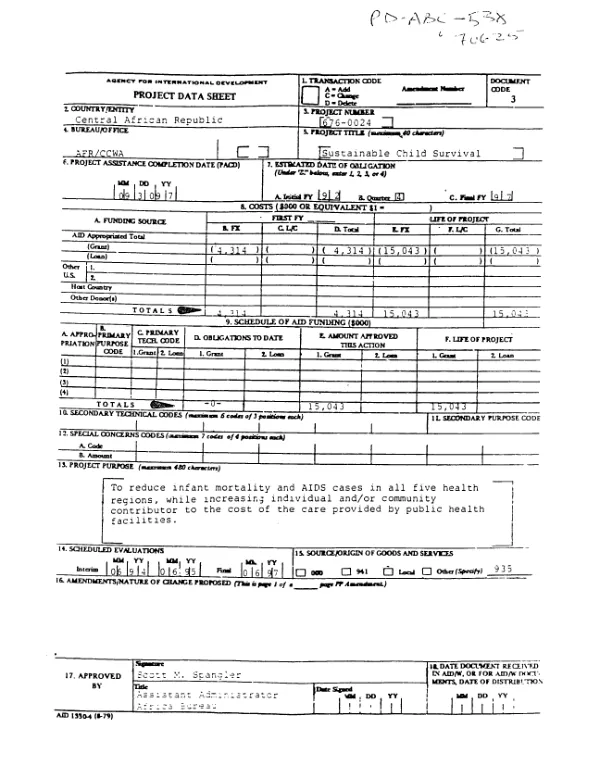
ACSI/CCCD project (CAR)
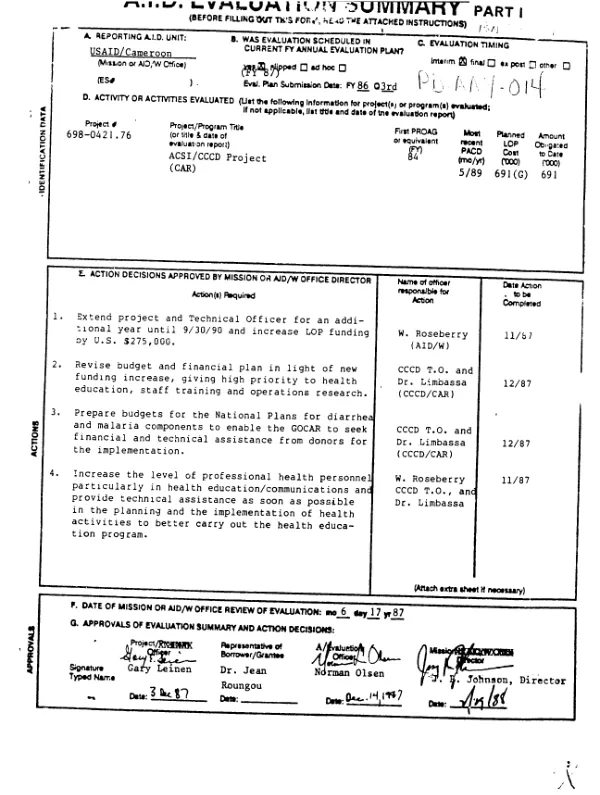
Summarizes external evaluation (PD-JAE-752) of the African Child Survival Initiative/Combating Childhood Communicable Diseases (CCCD) subproject in the Central African Republic.
Brown, V.; Huber, J. · 1988
Sign in to readA free account is required to download.
Abstract
The evaluation covered the period 1984-11/87 and included field visits to a representative sample of health facilities. The evaluation yielded the following major findings: (a) the CCCD program seems to be fairly well integrated into the existing primary health care (PHC) delivery system; (b) despite the lack of a formal committee for donor coordination, there has been considerable donor coordination on an informal basis, among donors concerned with child survival and PHC; (c) given the considerable start-up time that was required to assemble the necessary baseline data and prepare the multiyear action plans, four full operational years will be needed (from early 1986) to achieve CCCD objectives; and (f) it is very unlikely that the Government of the Central African Republic (GCAR) will be able to cover the minimum recurrent costs of the CCCD program by the PACD. Based on the above findings, the team recommended, among other things, that the project be extended by one year (with additional funding) and that TA be provided to the GOCAR in finding ways of generating the needed revenue for health care. The evaluation of this project has clearly demonstrated that in countries where there is strong reservation by the host government about formal structures for donor coordination, informal coordination channels can be just as effective in increasing communication and cooperation among donors and between the donor community and the host government. See also abstract of PD-JAE-752. (Author abstract)
Related documents