USAID. MISSION TO BOLIVIA
CARE community development project
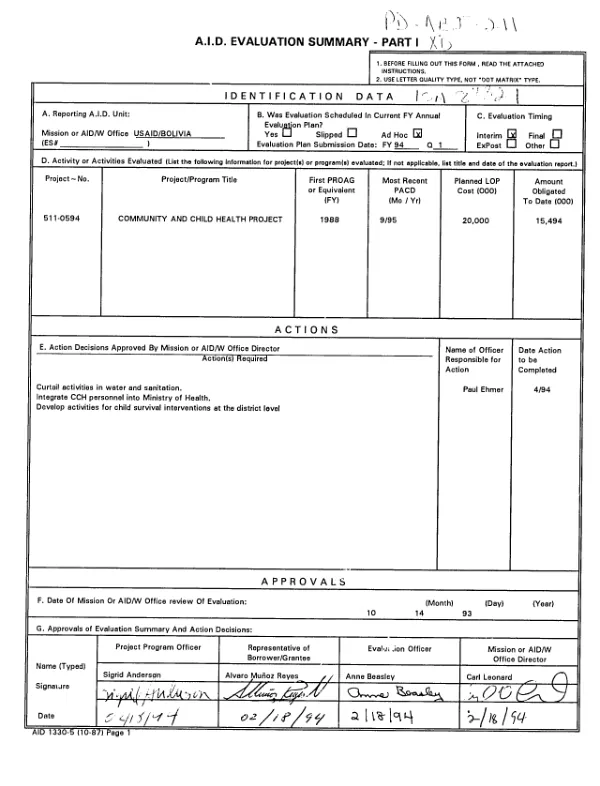
Summarizes attached mid-term evaluation (XD-ABI-845-A) of a project to improve infant and child survival in rural Bolivian villages through improved nutrition and immunization.
1994
Sign in to readA free account is required to download.
Abstract
The project has been implemented by CARE. Evaluation covers the period 3/91-5/94. Progress has been significant in two of the project"s components. The Primary Health Care component has the potential to meet its goals, particularly those for immunization, weight gain, and oral rehydration therapy. However, no strategy has been developed for the transfer of the component"s activities into the hands of the Ministry of Health, and local health systems have not been strengthened. The Potable Water and Rural Sanitation component has achieved 45% of its planned outputs, including the construction of high-quality potable water systems and latrines, which are being used in a sanitary manner. However, the Project Paper underestimated the number of personnel needed to reach the component"s goal. The project"s remaining two components have been less successful. The Crop/Animal Production component, initiated to complement the project"s nutrition objectives, has received only secondary attention, little or no participation from counterparts, and has been inappropriate in many communities, which were selected for their ability to participate in water system development rather than agricultural development. The Nutrition component, which develops family gardens, has been constrained by insufficient personnel, the wide dispersement of the many target communities, limited supervisory follow-up, insufficient training, and failure to link gardening to improved nutrition. It is recommended that a model communal garden be used to demonstrate the production and preparation of balanced meals for children; and that local products, such as cereals and vegetables, be promoted to complement garden-based diets. The following lessons were learned. (1) Large integrated development projects should have clear goals and strategies by which to measure project impact and sustainability. (2) To be fully integrated into development projects women should take on roles traditionally reserved for men, particularly those associated with community-level decision making. Similarly, men should participate in activities traditionally assigned to women. (3) Four years is little time in which to effect significant social change. (4) Large projects are more effectively implemented when their target geographical areas are consolidated rather than dispersed.
Related documents