USAID DEC
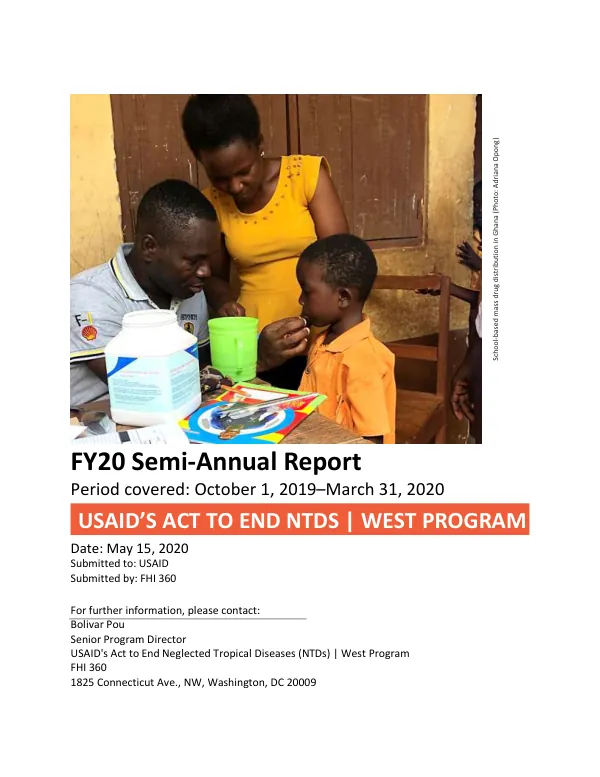
Act to End NTDS | West FY20 Semi-annual Report (SAR): October 1, 2019–March 31, 2020
Sign inDELOITTE INC.
Act to End NTDS | West FY20 Semi-annual Report (SAR): October 1, 2019–March 31, 2020
The Act to End Neglected Tropical Diseases (NTDs) | West Program is a collaborative effort led by FHI 360 in partnership with several organizations, including Helen Keller International, Health and Development International, Deloitte, World Vision, Americares, and The AIM Initiative.
2020 · 362 pages
Sign in to readA free account is required to download.
Abstract
The program is funded by the United States Agency for International Development (USAID) under Cooperative Agreement No. 7200AA18CA00011. The program's main objective is to increase mass drug administration (MDA) coverage among at-risk populations in endemic countries. To achieve this goal, the program has implemented several activities, including strengthening national plans with quality data, completing trachoma mapping for remaining Act | West countries, and delivering MDA in endemic areas. The program has also focused on improving the quality of NTD interventions through quality assurance and quality improvement (QA/QI) activities. In addition to increasing MDA coverage, the program aims to promote sustainable NTD elimination and control. This is achieved through activities such as pursuing collaboration with USAID to promote the NTD sustainability framework and strategy, creating sustainability plans in partnership with host country governments, and operationalizing the finance strategy for NTD control and elimination interventions. The program has also explored alternative in-country financing mechanisms to mobilize domestic resources and diversify sources of funding. The program has made significant progress in implementing its activities, with notable achievements including a 27% increase in household income among program participants compared to the control group. The program has also focused on monitoring, evaluation, and learning (MEL) activities to ensure that its interventions are effective and sustainable. This includes promoting the use of WHO's Supervisor Coverage Tool (SCT) to improve coverage during MDAs, assisting with coverage evaluation surveys (CES) to evaluate coverage after MDAs, and training on and assisting with data quality assessment (DQA) on MDA indicators. The program has also cooperated with the Transition Task Force to support the USAID NTD database and data system transition. This has involved continuing to strengthen existing USAID NTD data input and data output products in support of both reporting to USAID and decision making for program implementation. The program has also developed and refined indicators to track and monitor IR2/IR3 activities, including the use of electronic data collection (EDC) for disease-specific assessments (DSAS) and the promotion of the use of the Integrated Database for data management, tracking of trends, drug applications, and data archiving.
Related documents