USAID DEC
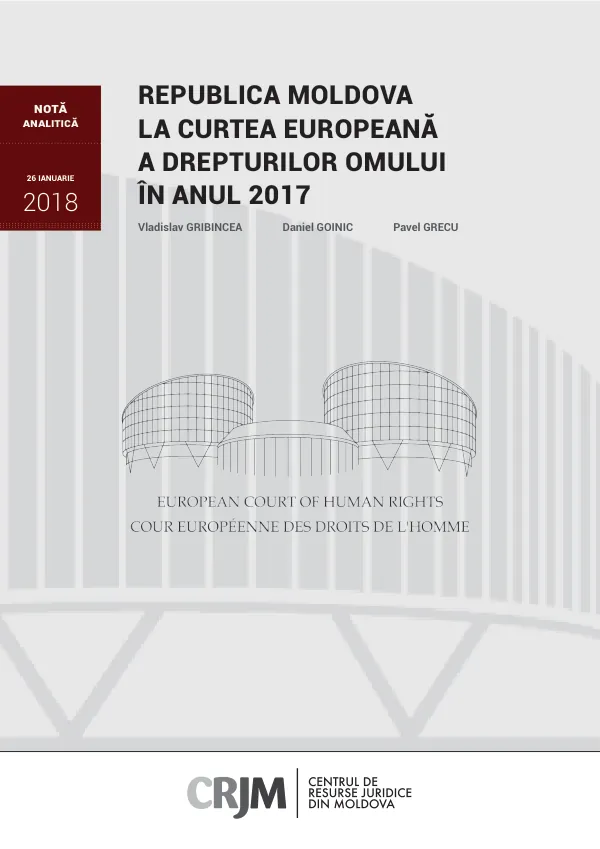
Activitatea Curții Europene a Drepturilor Omului în cauzele moldovenești în anul 2017
Sign inUSAID DEC
Activitatea Curții Europene a Drepturilor Omului în cauzele moldovenești în anul 2017
The activity of the European Court of Human Rights (ECHR) in cases involving the Republic of Moldova in 2017 was analyzed by the Center for Judicial Resources in Moldova (CRJM).
2018 · 14 pages
Sign in to readA free account is required to download.
Abstract
The analysis was based on the ECHR's Activity Report for 2017 and the analysis of the ECHR's jurisprudence in Moldovan cases. In 2017, the ECHR received 758 complaints against Moldova, a 9% decrease from 2016. The decrease is likely due to the decline in popularity of the ECHR, following the rejection of over 8,600 Moldovan complaints without explicit motivation between 2011 and 2016, which had a discouraging effect on lawyers. This trend is also observed in other countries. The high rate of complaints against Moldova is due to the lack of improvement in the respect for human rights. Moldova has the highest rate of complaints per capita in Europe, with 3 times more complaints than the European average. The number of pending complaints is also high, with 1,348 complaints awaiting examination, 89% of which have a high chance of success. The ECHR has pronounced 354 judgments in Moldovan cases, including 16 in 2017. Moldova has the highest number of judgments per capita in Europe, surpassing Germany, Spain, and the Netherlands, which have a much larger population and have been members of the European Convention on Human Rights (ECHR) for a longer time. In 2017, the ECHR found 14 violations of the ECHR in 16 judgments, with 8 of these (60%) related to Articles 3 and 5 of the ECHR. The most important judgments in 2017 include Braga, Ialamov, and Șolari, which relate to detention, arbitrary arrest, and administrative sanctions. As a result of the ECHR's judgments and decisions, the Government of the Republic of Moldova has been ordered to pay over EUR 16.3 million. This amount is higher than the entire budget of the judiciary for 2015. The analysis of the ECHR's activity in Moldovan cases highlights the need for improvement in the respect for human rights and the rule of law in the country. The high number of complaints and pending cases indicates a lack of trust in the judiciary and the need for reforms to ensure the effective protection of human rights. The ECHR's jurisprudence in Moldovan cases shows a consistent pattern of violations of human rights, including non-execution of court judgments, inadequate investigation of torture and deaths, detention in poor conditions, and arbitrary administrative sanctions. The ECHR has found that the Republic of Moldova has violated the ECHR in 2.8% of cases, with the majority of these violations related to non-execution of court judgments, inadequate investigation of torture and deaths, and detention in poor conditions. The analysis of the ECHR's activity in Moldovan cases is based on the ECHR's Activity Report for 2017 and the analysis of the ECHR's jurisprudence in Moldovan cases. The report provides an overview of the ECHR's activity in Moldovan cases, including the number of complaints, judgments, and decisions, as well as the types of violations found by the ECHR. The analysis of the ECHR's activity in Moldovan cases is an important tool for understanding the human rights situation in the country and identifying areas for improvement. The report provides a comprehensive overview of the ECHR's activity in Moldovan cases and highlights the need for reforms to ensure the effective protection of human rights.