USAID DEC
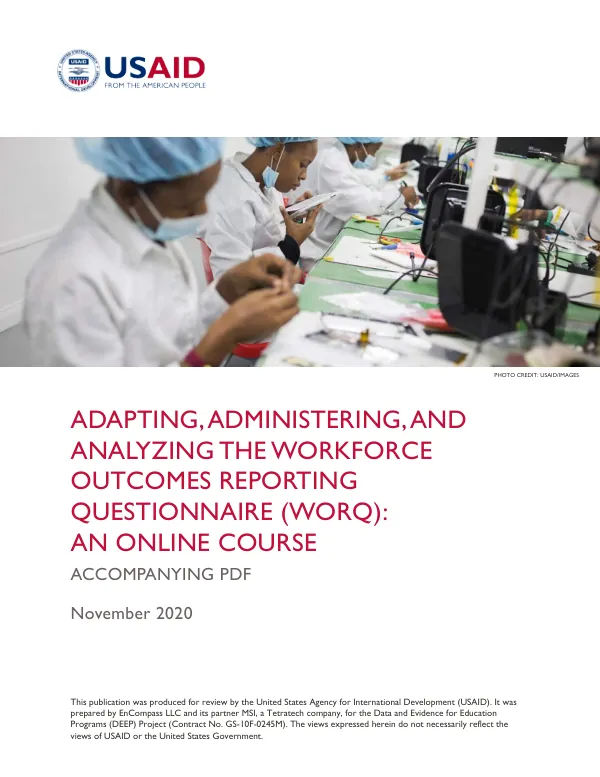
Adapting, Administering, and Analyzing the Workforce Outcomes Reporting Questionnaire (WORQ): An Online Course
Sign inENCOMPASS, LLC
Adapting, Administering, and Analyzing the Workforce Outcomes Reporting Questionnaire (WORQ): An Online Course
The Workforce Outcomes Reporting Questionnaire (WORQ) suite of tools is a set of four data collection tools developed by USAID to support organizations reporting on youth workforce outcomes.
2020 · 80 pages
Sign in to readA free account is required to download.
Abstract
The WORQ tools measure outcomes for youth workforce development activities, including skills training, career counseling, internship placement, job matching, linking self-employed youth to skills development, and entrepreneurship training. These activities focus on employment that is not on a family farm, as the WORQ tools have been tested for those settings and may not accurately measure earnings from a family farm. The WORQ tools are designed to collect data from people who participated in a youth workforce development activity, including those who dropped out of the program. The tools can be used with either a census of all program participants or a sample, which should be representative of the participant population and sufficiently large to draw conclusions about the entire population and sub-populations of interest. If conducting an impact evaluation, a control group similar to the treatment group should also be sampled. The WORQ tools measure three key indicators: two related to youth workforce development outcomes and one related to the transition to further education. These indicators include the average percent change in earnings following participation in U.S. Government (USG)-assisted workforce development programs, the percentage of participants who transition to further education, and the percentage of participants who are employed. The WORQ suite of tools includes four data collection tools: the Extra WORQ, the Impact WORQ, the Quick WORQ, and the WORQ Data Reporting Form. Each tool has a specific purpose and is designed to support organizations in reporting on youth workforce outcomes. The Extra WORQ is used to collect additional data on participants, the Impact WORQ is used to evaluate the impact of a program, the Quick WORQ is used to collect data on a small number of participants, and the WORQ Data Reporting Form is used to report on the required indicators. The WORQ tools are not proprietary and are free to use for any activity that is measuring youth workforce development outcomes. The tools are available on EducationLinks, and USAID has developed an online course to train individuals and organizations on how to prepare, implement, and analyze the WORQ suite of tools. The course is designed to support organizations in using the WORQ tools effectively and efficiently. The online course has four modules, each with a different focus. Module 1 provides an overview of the WORQ suite of tools and explains what they can be used for. Module 2 focuses on adapting the WORQ tools, including describing the timeline and resources necessary to adapt the tools, defining the parameters and recommended approaches for adapting the tools, and identifying the specific questions in the WORQ tools that are necessary to calculate the standard foreign assistance indicators. Module 3 focuses on administering the WORQ tools, including explaining why the semi-structured interview approach is recommended for using the WORQ tools, identifying what to look for when reviewing WORQ data during a data quality assessment (DQA), and assessing whether WORQ data meets the requirements in the data quality checklist. Module 4 focuses on analyzing the WORQ tools, including using baseline data from the WORQ tools to make programmatic and implementation-related decisions, describing the formulas for reporting on the required indicators, and calculating the required indicators using the WORQ Data Reporting Form. Overall, the WORQ suite of tools is a valuable resource for organizations working on youth workforce development activities, and the online course provides a comprehensive training program to support organizations in using the tools effectively.