ENCOMPASS, LLC
2019 Snapshot of USAID Activities in Education
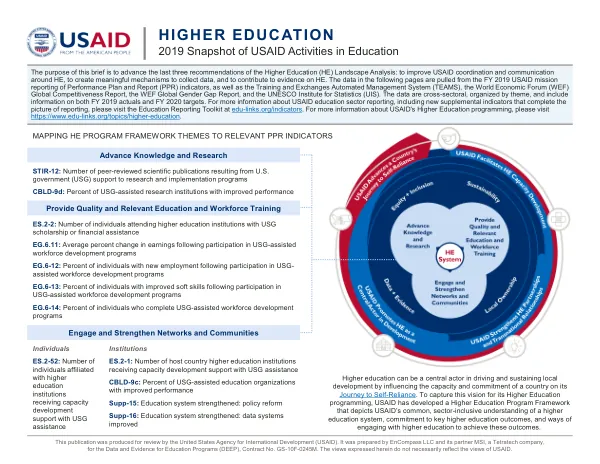
The Higher Education Landscape Analysis, conducted by the United States Agency for International Development (USAID), aimed to improve coordination and communication around higher education.
2019 · 6 pages
Sign in to readA free account is required to download.
Abstract
The analysis identified three key recommendations: to improve USAID coordination and communication, to create meaningful mechanisms to collect data, and to contribute to evidence on higher education. To address these recommendations, USAID developed a Higher Education Program Framework that depicts the agency's common understanding of a higher education system, commitment to key higher education outcomes, and ways of engaging with higher education to achieve these outcomes. The framework focuses on four key themes: Advance Knowledge and Research, Provide Quality and Relevant Education and Workforce Training, Engage and Strengthen Networks and Communities, and Strengthen Institutions. The Advance Knowledge and Research theme aims to improve the quality and relevance of research and implementation programs, while the Provide Quality and Relevant Education and Workforce Training theme focuses on providing access to quality education and workforce training. The Engage and Strengthen Networks and Communities theme seeks to strengthen networks and communities, and the Strengthen Institutions theme aims to improve the capacity and commitment of institutions. To measure progress towards these goals, USAID uses a range of indicators, including the Performance Plan and Report (PPR) indicators. The PPR indicators provide data on the number of peer-reviewed publications, the number of individuals attending higher education institutions with USG scholarship or financial assistance, and the number of host country higher education institutions receiving capacity development support with USG assistance. The data are organized by theme and include information on both FY 2019 actuals and FY 2020 targets. The data show that in FY 2019, 1,275 peer-reviewed publications were reported globally, with a target of 576 publications for FY 2020. The number of individuals attending higher education institutions with USG scholarship or financial assistance was 12,297 in FY 2019, with a target of 11,098 individuals for FY 2020. The number of host country higher education institutions receiving capacity development support with USG assistance was 574 in FY 2019, with a target of 569 institutions for FY 2020. In addition to the PPR indicators, USAID also uses non-PPR data to measure progress towards its higher education goals. The non-PPR data include information on tertiary school enrollment rates, the proportion of the population obtaining a bachelor's degree, skillsets of graduates, quality of research institutions, quality of vocational training, industry-university collaboration in R&D, and enrollment in tertiary education. The data are organized by country and show trends over time. For example, in Afghanistan, the tertiary school enrollment rate increased from 9.7% in 2018 to n/a in 2019. In Benin, the proportion of the population obtaining a bachelor's degree increased from 0.43% in 2018 to 0.38% in 2019. In Colombia, the skillsets of graduates increased from 9.10 in 2018 to 12.77 in 2019. In Egypt, the quality of research institutions increased from 15.30 in 2018 to 14.83 in 2019. In India, the quality of vocational training decreased from 99.10 in 2018 to 98.36 in 2019. In Indonesia, the industry-university collaboration in R&D increased from 4.20 in 2018 to 10.61 in 2019. In Jordan, the enrollment in tertiary education increased from 2.60 in 2018 to 3.70 in 2019. In Kazakhstan, the quality of vocational training increased from 0.80 in 2018 to 1.46 in 2019. In Kenya, the skillsets of graduates decreased from 2.30 in 2018 to 3.60 in 2019. In Kyrgyz Republic, the quality of vocational training decreased from 0 in 2018 to 0 in 2019. In Lebanon, the quality of vocational training decreased from 1.90 in 2018 to 3.08 in 2019. In Liberia, the enrollment in tertiary education was n/a in 2019. In Malawi, the quality of vocational training increased from 0.44 in 2018 to 0.42 in 2019. In Morocco, the quality of vocational training increased from 5.80 in 2018 to 5.90 in 2019. In Mozambique, the quality of vocational training decreased from 0.40 in 2018 to 0.38 in 2019. In Nepal, the quality of vocational training decreased from 0.40 in 2018 to 1 in 2019. In Pakistan, the quality of vocational training decreased from 0.40 in 2018 to 1 in 2019. In Rwanda, the quality of vocational training decreased from 0.40 in 2018 to 1 in 2019. In South Africa