USAID
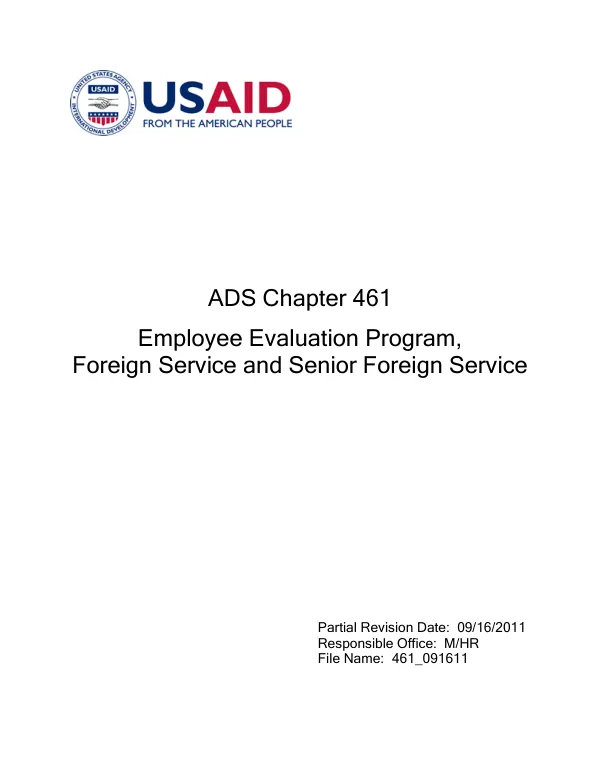
ADS 461 - Employee Evaluation Program, Foreign Service and Senior Foreign Service
The Employee Evaluation Program (EEP) for Foreign Service and Senior Foreign Service employees is a systematic process designed to improve organizational effectiveness and accomplish the Agency's mission and goals.
2011 · 21 pages
Sign in to readA free account is required to download.
Abstract
The program establishes clear linkages among the Agency's goals, Operating Unit strategic objectives, and employees' work. It also improves communications about organizational objectives and individual career goals, develops the capacity to perform, provides feedback to employees, corrects deficiencies, and provides a basis for cash awards, bonuses, and pay adjustments based on performance. The EEP applies to all Foreign Service and Senior Foreign Service employees under the authority of Sections 601-605 of the Foreign Service Act of 1980, as amended. The program does not apply to Civil Service employees, Presidential Appointees, Senior Executive Service employees, or experts and consultants under the authority of 5 U.S.C. 43 and 5 CFR 430, Performance Management, Subpart B, Performance Appraisal for General Schedule, Prevailing Rate and Certain Other Employees. The EEP for Civil Service employees is outlined in ADS 462. The Principal Officer of an Operating Unit is responsible for managing the performance evaluation program, including communicating objectives, goals, policies, procedures, and deadlines, ensuring compliance with the program, designating employees to play particular roles in the program, and keeping the Bureau for Management, Office of Human Resources (M/HR) abreast of important information concerning the EEP. The Rating Official is responsible for working closely with individual employees throughout the review cycle to create performance plans, evaluate performance, provide feedback, and revise plans as appropriate. Employees are responsible for participating in their own evaluation from beginning to end, including helping to develop their performance plans, working toward the goals specified in the plan, evaluating themselves, and participating in review and feedback sessions. The Appraisal Committee reviews and discusses Annual Evaluation Forms (AEFs) with Rating Officials, provides input to the evaluation, and formally approves the AEF. Skills Feedback Worksheets (SFWs) must be completed, shared with the employee, and made readily available for possible AC review. The Bureau for Management, Office of Human Resources (M/HR) is responsible for the program's formulation, monitoring, modification, and training, as well as taking action against those who fail to comply with the program. The EEP begins with the Principal Officer of each Operating Unit, who establishes overall Operating Unit strategic objectives and communicates to employees the relationships among Agency goals and the Operating Unit's strategic objectives. The Principal Officer also communicates information on the evaluation process to all employees in the unit, including establishing and publicizing internal deadlines and procedures for completing each phase of the process. The Principal Officer ensures the Operating Unit's adherence to Agency policies, procedures, and schedules governing the EEP and notifies M/HR of action that should be taken against employees who have failed to adhere to the policies, procedures, and schedules of the EEP. In turn, M/HR initiates appropriate action against employees who fail to comply with the program. The EEP involves several key components, including appraisal input forms, rating officials, appraisal committees, annual evaluation forms, performance plans, deficient performance, progress reviews, gathering appraisal information, employee self-assessments, 360-degree input sources, final AEFs, skills matrices, potential, employee feedback sessions, and AC review of the final evaluation. The program also includes mandatory references, additional help, and definitions.
Related documents