ACDI/VOCA
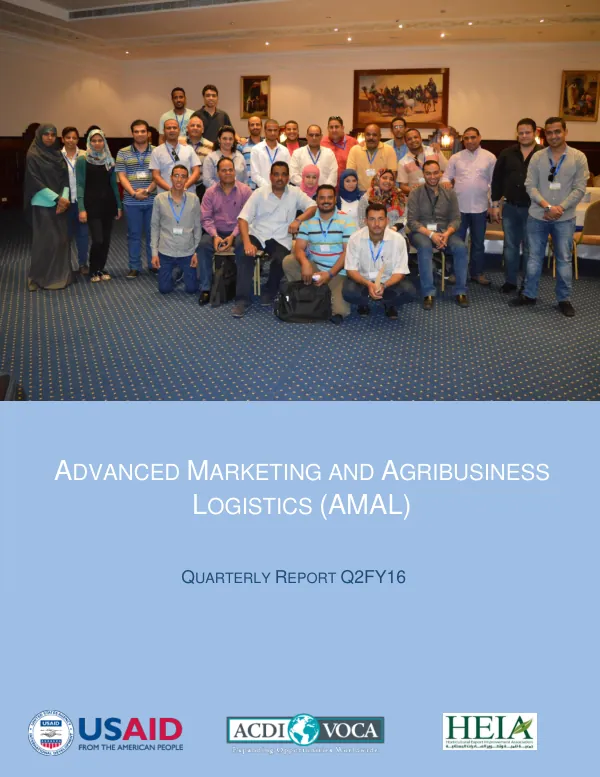
Advanced Marketing and Agribusiness Logistics (AMAL) Quarterly Report Q2FY16
The Advanced Marketing and Agribusiness Logistics (AMAL) project aims to improve the livelihoods of 4,300 rural households in Upper Egypt by building their capacity to integrate into high-value commercial horticulture markets.
2016 · 45 pages
Sign in to readA free account is required to download.
Abstract
The project is a three-year USAID-funded initiative that seeks to promote agricultural productivity and trade, and improve livelihoods in Upper Egypt. ACDI/VOCA is the implementing partner on the project, partnering with the Horticulture Export Improvement Association (HEIA) to leverage HEIA's investment in the construction of the Center of Excellence (COE) in Upper Egypt. The primary goal of the AMAL project is to improve the livelihoods of rural household members in Upper Egypt, including smallholder farmers, landless laborers, women, unemployed youth, and entrepreneurs. The project will achieve this goal by building their capacity to integrate into high-value commercial horticulture markets, employing a market-driven approach to increase smallholder incomes by sustainably intensifying their productivity, improving the ability of value chain stakeholders to interpret and respond to market signals, enhancing marketing of products, and facilitating commercially oriented linkages between value chain actors. The project is divided into four components: Improving Access and Use of Market Intelligence, Facilitating Value Chain Linkages, Catalyzing Market-Oriented Production Practices, and Organizing and Strengthening Producer Organizations. The project works closely with HEIA to build the capacity of the COE to provide relevant, market-driven services to horticulture value chain stakeholders. During the second quarter of the fiscal year 2016, AMAL witnessed significant success with various beneficiary groups. The project successfully completed the capstone training course, which brought together different beneficiary groups from different governorates in a highly interactive and condensed training course. The project also achieved several key milestones, including engaging 743 beneficiaries with AMAL activities, with 55% being farmers. Additionally, 100% of AMAL farmers who grew green beans under contract applied at least one form of improved technology to 100% of the land cultivated. The project also facilitated the development of marketing plans by eight associations to supply high-value markets with high-quality produce. AMAL beneficiary associations bumped $217,000 worth of exports into the international markets, and twelve associations engaged with AMAL to date. Furthermore, through successful contractual agreements between AMAL beneficiary associations and exporters, small growers received $43,300 of advance from the buyers in the form of cash advance and in-kind inputs. The project's anticipated outcomes include beneficiaries equipped with marketing skills and practices required to improve their access to markets and the use of market intelligence, linkages established between smallholder farmers in Upper Egypt and processors/exporters, a perishable terminal established and operational in Upper Egypt to support smallholder producers, and an increase in the agricultural area in Upper Egypt under improved technologies. The project's progress on these outcomes will be closely monitored and evaluated to ensure that the project is on track to achieve its goals.