ACDI/VOCA
Advanced Marketing and Agribusiness Logistics (AMAL) Quarterly Report Q3 FY15
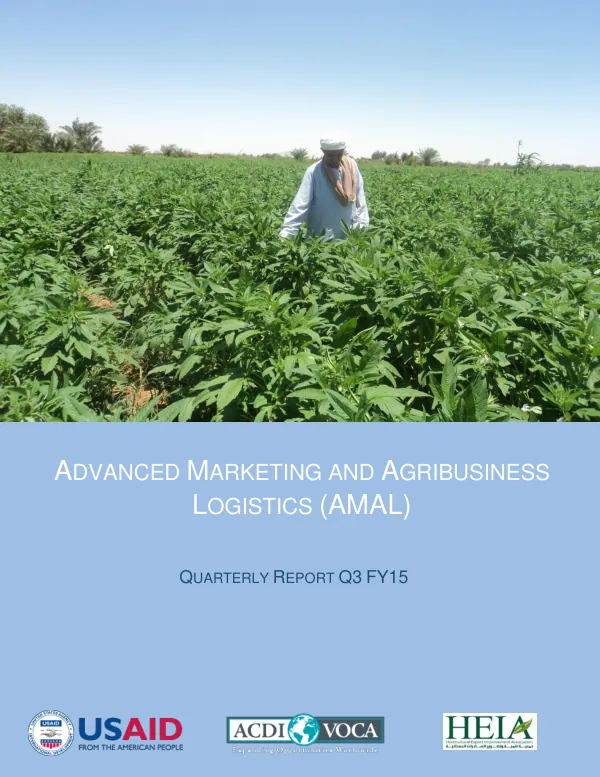
The Advanced Marketing and Agribusiness Logistics (AMAL) project is a three-year USAID-funded initiative aimed at increasing the integration of smallholder farmers into high-value markets, promoting agricultural productivity and trade, and improving livelihoods in Upper Egypt.
2015 · 22 pages
Sign in to readA free account is required to download.
Abstract
The project is implemented by ACDI/VOCA in partnership with the Horticulture Export Improvement Association (HEIA) and is focused on the Upper Egypt governorates of Aswan, Luxor, Qena, and Sohag. The primary goal of the AMAL project is to improve the livelihoods of 4,300 rural household members in Upper Egypt, including smallholder farmers, landless laborers, women, unemployed youth, and entrepreneurs. The project aims to achieve this goal by building the capacity of smallholder farmers to integrate into high-value commercial horticulture markets, employing a market-driven approach to increase smallholder incomes by sustainably intensifying their productivity, improving the ability of value chain stakeholders to interpret and respond to market signals, enhancing marketing of products, and facilitating commercially oriented linkages between value chain actors. The project activities are divided across four components: Improving Access and Use of Market Intelligence, Facilitating Value Chain Linkages, Catalyzing Market-Oriented Production Practices, and Organizing and Strengthening Producer Organizations. The project works closely with HEIA to build the capacity of the Center of Excellence (COE) to provide relevant, market-driven services to horticulture value chain stakeholders, which will be key to the sustainability of the project. During the third quarter of fiscal year 2015, the project made significant progress in implementing its activities. The project completed the staffing for the AMAL project, submitted the Monitoring and Evaluation (M&E) plan to USAID, held the post-award meeting with USAID, finalized the procurement of necessary items to operate the Luxor packhouse, completed the baseline study for project beneficiaries, submitted the first draft of the Cost Benefit Analysis (CBA), and identified the associations to engage in AMAL activities. The project also held an orientation meeting at the Horticulture Export Improvement Association (HEIA) premises to agree on the roles of each partner. The project's activities are designed and executed in close coordination with HEIA to ensure sustainability of project interventions. These activities complement infrastructure, such as the perishable terminal, facilitate the integration of smallholder farmers into commercial horticulture production systems, and position HEIA's COE as an information and service hub in Upper Egypt. The project's sustainability approach includes the integration of agricultural university graduates into training programs across all of the project components. This approach creates employment opportunities for graduates and creates a sustainable knowledge resource base that horticulture value chain actors can draw on for assistance as they access horticulture markets. HEIA will be able to hire those newly-trained professionals to provide fee-based farm management and production support to exporters sourcing from smallholder farmers in Upper Egypt. The project also collaborates with the Premium Project, which is working with the Agricultural Technical Schools (ATS), to identify promising ATS graduates to attend training programs at the COE. The project's implementation progress is closely monitored and evaluated to ensure that the project is on track to meet its objectives and to identify areas for improvement. The project's activities are designed to improve the livelihoods of smallholder farmers and other rural household members in Upper Egypt. The project's focus on building the capacity of smallholder farmers to integrate into high-value commercial horticulture markets, employing a market-driven approach to increase smallholder incomes, and improving the ability of value chain stakeholders to interpret and respond to market signals are key to achieving this goal. The project's sustainability approach, which includes the integration of agricultural university graduates into training programs and the creation of a sustainable knowledge resource base, will help to ensure that the project's interventions are sustained beyond the project's lifespan.