USAID DEC
Advancing Advocacy Efforts to Meet the Sexual and Reproductive Health Needs of Youth in Angola
Sign inMINISTRY OF HEALTH
Advancing Advocacy Efforts to Meet the Sexual and Reproductive Health Needs of Youth in Angola
The maternal mortality rate in Angola is high, with 460 deaths per 100,000 live births.
2016 · 8 pages
Sign in to readA free account is required to download.
Abstract
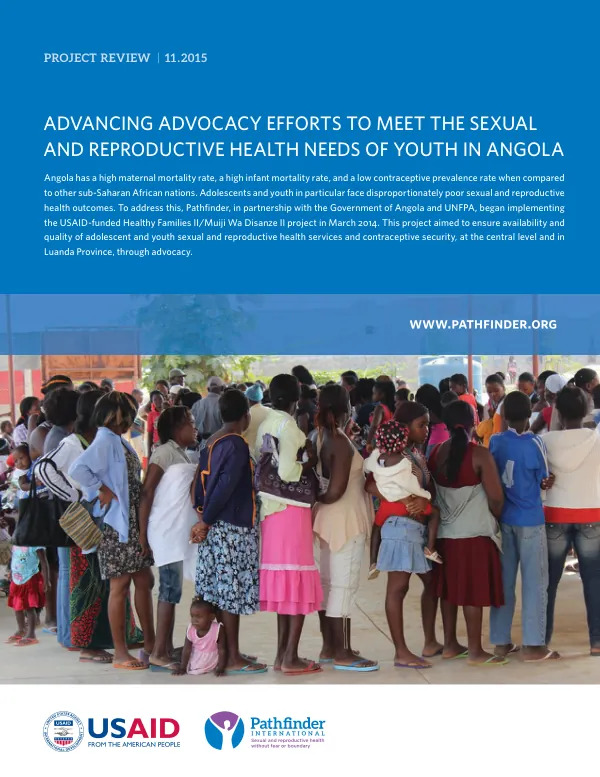
The infant mortality rate is also high, with 95 deaths per 1,000 live births. Women in Angola face a 1 in 39 lifetime risk of maternal death. The contraceptive prevalence rate is low, with 18 percent of women between the ages of 15 and 49 using contraception. The total fertility rate is 6.1 births per woman, one of the highest in the world. Adolescents and youth in Angola face disproportionately poor sexual and reproductive health outcomes. Socio-economic and cultural factors contribute to these poor outcomes, including a pro-natalist society where having a large family is seen as a sign of power or wealth. Women are often viewed as ready to marry when they have demonstrated their fertility, rather than when they have reached a certain age. This contributes to low contraceptive prevalence among young women, with a rate of 12.4 percent for modern methods among women aged 15 to 19 living in union. Having children at a young age carries serious risks for the health of young girls, including an increased risk of maternal death and disability. Opportunities for education, work force training, and livelihood development are frequently curtailed for adolescent mothers. Delaying the first birth by ensuring adolescents have access to contraception can have a positive effect on maternal morbidity and mortality, as well as Millennium Development Goal 5. In response to the sexual and reproductive health needs in Angola, Pathfinder International's USAID-funded Healthy Families project collaborated with the Angolan Ministry of Health to reposition family planning as a national strategy. The project focused on creating an enabling environment for family planning advocacy and contraceptive security. Phase I of the project strengthened the national commodity supply management system through an initial assessment of the supply chain, developing and distributing standardized tools for supply chain management, and building local human resource capacity in contraceptive logistics best practices. The project also assisted with drafting a National FP Strategy for the Ministry of Health, outlining the ways the Government of Angola could advance its commitment to reducing maternal and infant morbidity and mortality. One proposed approach was to strategically implement a focus on adolescent and youth sexual and reproductive health within a comprehensive FP strategic framework. Phase II of the project targeted advocacy for quality, sustainable, youth-friendly FP services in urban and rural settings throughout the country, and building the capacity for local organizations to advocate specifically for the SRH needs of adolescent and youth populations. To achieve these goals, the Healthy Families project used two approaches: advocating with the Government of Angola at central and local levels for improved quality of and access to SRH services for youth, and strengthening the capacity of two local youth-focused nongovernmental organizations (NGOs) to design and implement SRH advocacy action plans focused on advancing AYSRH services in Luanda Province. At the core of SRH services for youth is advancing contraceptive use for healthy timing and spacing of pregnancies (HTSP), which can reduce the likelihood of pre-term, low birth weight, and small-for-gestational-age babies, thus lowering neonatal mortality.
Related documents