PALLADIUM INTERNATIONAL, LLC
USAID Afya Pwani Adolescent And Youth Sexual And Reproductive Health Program Brief
The adolescent and youth sexual and reproductive health (AYSRH) program in Kilifi County, Kenya, aimed to improve access to and use of quality health services among young people.
2021 · 6 pages
Sign in to readA free account is required to download.
Abstract
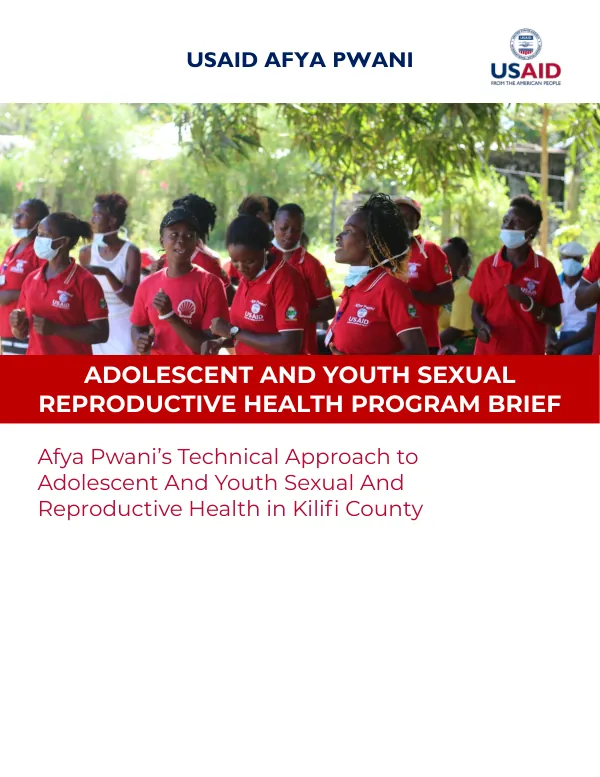
The program, led by USAID Afya Pwani, was implemented from 2016 to 2021 and focused on increasing demand for SRHR information and services, increasing access and use of quality AYSRHR services, strengthening quality of youth-friendly services in health facilities, and strengthening county capacity to plan, coordinate, and implement AYSRH activities. Young people under 25 years of age constitute about 66% of the total population in Kenya, and those in Kilifi County experience some of the poorest SRH and HIV outcomes. The county had one of the highest adolescent pregnancy rates in Kenya at 22% as of 2014, with 18% of young women ages 15 to 49 having begun childbearing, 15% having already had a live birth, and 3% being pregnant with their first child. The age of sexual debut was 14 years, with a low modern contraceptive prevalence rate (m-CPR) of 20% among adolescent girls and young women ages 15 to 24. The Afya Pwani project employed a multi-pronged approach to increase demand for SRHR information and services among young people. It conducted advocacy with political and administrative leadership, engaged existing youth groups and youth networks, conducted health drives, and leveraged sports to reach young people with information and services. The project strengthened the youth networks as avenues for social mobilization and cascading of age-specific SRHR information, with more than 3,600 members in Rabai, Kilifi North, and Magarini subcounties. The project also supported the county health management team (CHMT) and youth peer educators to conduct focus group discussions and dialogues with young people in Kilifi county to assess their perceptions of contraceptives, teen pregnancies, and barriers to using reproductive health services. The sessions sensitized the youth and community on HIV, maternal, newborn, and child health (MNCH), and contraception, thus creating awareness and demand for available services. To increase access and use of quality AYSRHR services, the project supported the CHMT to implement the high-impact approach of a group antenatal and postnatal (ANC/PNC) intervention dubbed 'Binti Kwa Binti' in 124 facilities, reaching 11,160 young women ages 10 to 24, including pregnant adolescents, with life skills, MNCH, and contraceptive information and services. The project also used digital platforms to increase access to contraceptives and link adolescents and young people to health services using structured SRH sessions on social media platforms like WhatsApp and Facebook, as well as bulk short message services (SMS). The project strengthened the capacity of health facilities to provide youth-friendly services by training health providers to offer youth-responsive services and equipping them with national AYSRH guidelines and job aids developed by the Ministry of Health with technical assistance from Pathfinder. The project promoted a mainstreamed, integrated approach to AYSRH service provision in 16 facilities and supported the county in setting up youth spaces. The project also supported the County and Subcounty health management teams (S/CHMT) to streamline youth activities in the county by supporting the development and implementation of the Kilifi county Adolescent and Young People Sexual Reproductive Health & HIV Strategy 2019-2022. It also contributed to the development of the Gender Policy and GBV Policy and supported the S/CHMT to conduct gender analysis and develop a gender action plan. Overall, the Afya Pwani project aimed to improve the SRH and HIV outcomes of young people in Kilifi County by increasing demand for SRHR information and services, increasing access and use of quality AYSRHR services, strengthening quality of youth-friendly services in health facilities, and strengthening county capacity to plan, coordinate, and implement AYSRH activities.
Related documents