THE HEALTH POLICY PROJECT
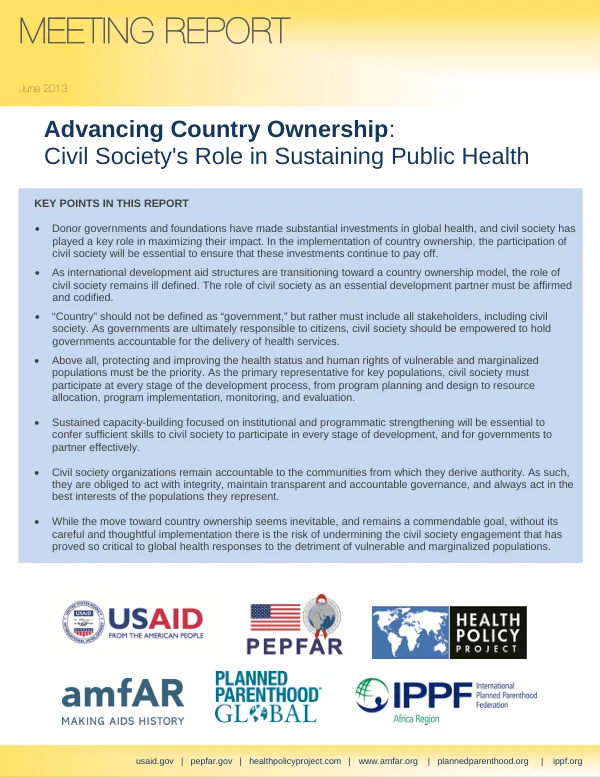
Advancing Country Ownership: Civil Society’s Role in Sustaining Public Health
Country ownership in global health development refers to the transition from a donor-led process to one featuring greater participation of in-country stakeholders.
2013 · 34 pages
Sign in to readA free account is required to download.
Abstract
This shift involves key stakeholders, primarily the government and civil society, taking the lead in drafting and monitoring development plans and priorities, coordinating aid, and using country health systems for aid delivery. The concept of country ownership is not new, dating back to the 1990s when the World Bank and International Monetary Fund began shifting focus to a development paradigm that emphasized good governance. While there is widespread international commitment to country ownership, many practical aspects, particularly the role of civil society, remain to be defined and are at times contested. Civil society organizations (CSOs) function as the primary representative of populations that are often marginalized and made vulnerable by stigma and discrimination. These populations include women and girls, young people, people living in poverty, people with HIV, racial and ethnic minority groups, and indigenous peoples. CSOs strive to ensure that these populations have a voice, access to comprehensive health and other essential services, and that such services are of high quality, respectful, and responsive to community needs and concerns. The integration of civil society in the development process has not been without challenges. Governments often neither welcome nor agree with CSOs' conclusions and recommendations, particularly when CSOs track funding allocations, monitor the quality of care in service delivery systems, and advocate for policies that expand access to services for marginalized or vulnerable populations. The United States Government has undertaken implementation of a country ownership approach in various ways. The Obama administration has consistently expressed its commitment to country ownership principles, and most U.S. programs have incorporated the language of country ownership into program plans. The Millennium Challenge Corporation (MCC) was the first USG program to explicitly incorporate country ownership principles, requiring partner countries to develop a constraints analysis and divest control of a five-year budget and implementation plan to the country. USAID's practice has been to redirect family planning resources away from countries once they have developed greater domestic capacity to countries where family planning needs are greater. In 2004, USAID began implementing a more formal and systematic process for "graduating" countries from family planning assistance. Over the past 40 years, USAID has graduated 22 countries, with current criteria for "imminent" graduation based on country-level indicators, including total fertility rates and use of modern contraceptives. The role of civil society in country ownership is essential to the success of the country ownership process. CSOs have played a pivotal role in the planning and implementation of family planning, maternal health, and HIV programs to date. Their inclusion will be vital to the success of the country ownership process, particularly in ensuring that marginalized and vulnerable populations have a voice and access to comprehensive health and other essential services. Sustained capacity-building focused on institutional and programmatic strengthening will be essential to confer sufficient skills to civil society to participate in every stage of development, and for governments to partner effectively. Civil society organizations remain accountable to the communities from which they derive authority, and are obliged to act with integrity, maintain transparent and accountable governance, and always act in the best interests of the populations they represent. The move toward country ownership seems inevitable, and remains a commendable goal. However, without its careful and thoughtful implementation, there is the risk of undermining the civil society engagement that has proved so critical to global health responses to the detriment of vulnerable and marginalized populations.
Related documents