USAID DEC
The Linkages across the Continuum of HIV Services for Key Populations Affected by HIV Project
Sign inFHI 360
The Linkages across the Continuum of HIV Services for Key Populations Affected by HIV Project
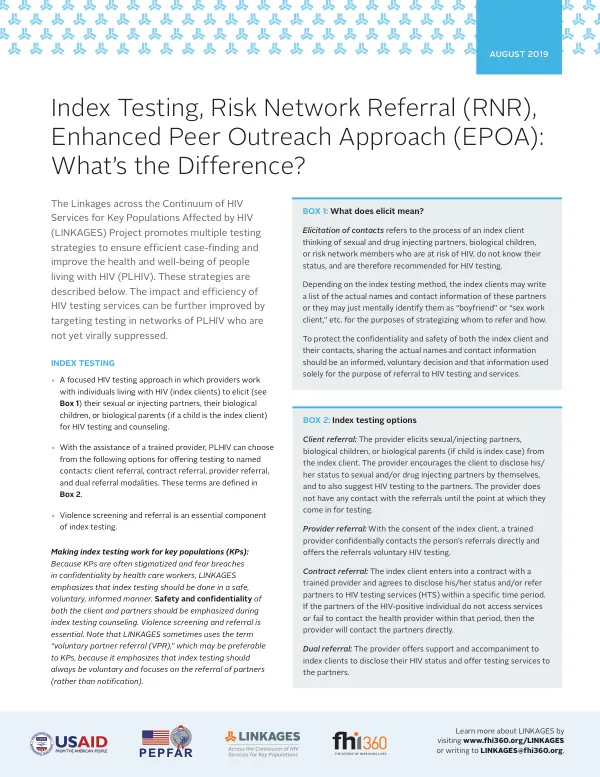
The Linkages across the Continuum of HIV Services for Key Populations Affected by HIV Project, also known as LINKAGES, is a project that aims to promote multiple testing strategies to ensure efficient case-finding and improve the health and well-being of people living with HIV.
2019 · 4 pages
Sign in to readA free account is required to download.
Abstract
The project focuses on key populations, including those who are stigmatized and fear breaches in confidentiality by healthcare workers. LINKAGES emphasizes that index testing should be done in a safe, voluntary, and informed manner, with a strong emphasis on safety and confidentiality for both the client and their partners. Index testing is a focused HIV testing approach in which providers work with individuals living with HIV to elicit their sexual or injecting partners, biological children, or biological parents for HIV testing and counseling. This approach can be conducted through various methods, including client referral, provider referral, contract referral, and dual referral modalities. Violence screening and referral are essential components of index testing. LINKAGES also emphasizes the importance of voluntary partner referral, which focuses on the referral of partners rather than notification. The treat and test approach, conceptualized by LINKAGES, requires that HIV services and healthcare providers focus on the health and well-being of the index client first, and then offer index testing and/or risk network referral to the client's partners and/or children. This approach prioritizes personalized support to people living with HIV, including offering multiple options for referring partners and risk network members to HIV testing, treatment, and prevention services. Risk Network Referral (RNR) is an approach that extends beyond index testing, offering people living with HIV additional, self-guided options to informally extend links to HIV testing and other services to a broader set of social- and risk-network members who have an elevated risk of HIV infection. RNR is conducted through online and coupon-based referrals, and does not require people living with HIV to name or know the names of their contacts to make referrals. This approach is often offered at the same time as index testing. The Enhanced Peer Outreach Approach (EPOA) uses performance-based incentives and works through social and sexual networks to improve HIV case-finding outcomes. Trained peer outreach workers invite members of key populations to become peer mobilizers, who in turn reach out to their social and sexual networks to encourage peers to get tested for HIV and seek other related services. EPOA may or may not be conducted by people living with HIV. Measurement and reporting of index testing, RNR, and EPOA are critical components of the LINKAGES project. Index testing approaches elicit only contacts who are sexual and/or injecting partners, biological children, or biological parents of the index client. RNR-style social network referrals are typically extended to a broader set of contacts at the discretion of the client, and EPOA HIV testing should generally be counted toward standard HIV testing services.