USAID DEC
Advancing Partners & Communities, Liberia: Improving Ebola Survivor Care and Building Resilient Health Systems
Sign inFHI360
Advancing Partners & Communities, Liberia: Improving Ebola Survivor Care and Building Resilient Health Systems
The Advancing Partners & Communities (APC) project in Liberia aimed to improve Ebola survivor care and build resilient health systems.
2018 · 2 pages
Sign in to readA free account is required to download.
Abstract
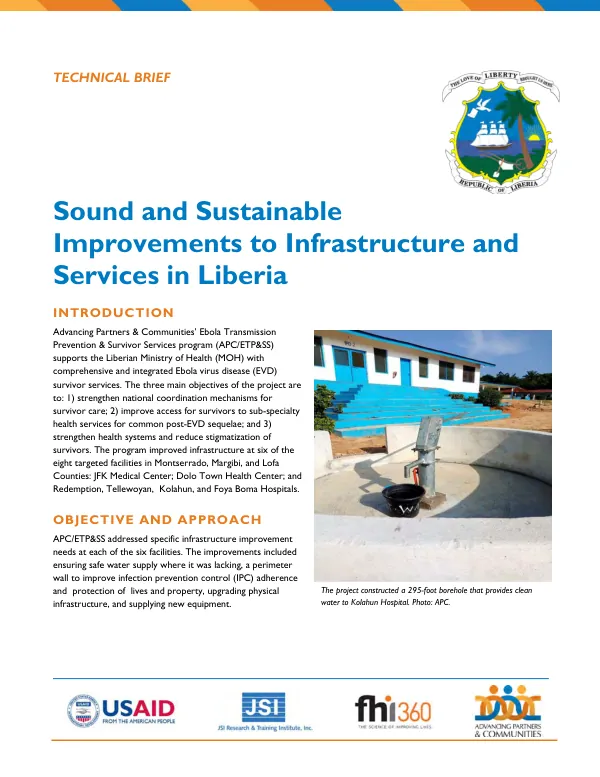
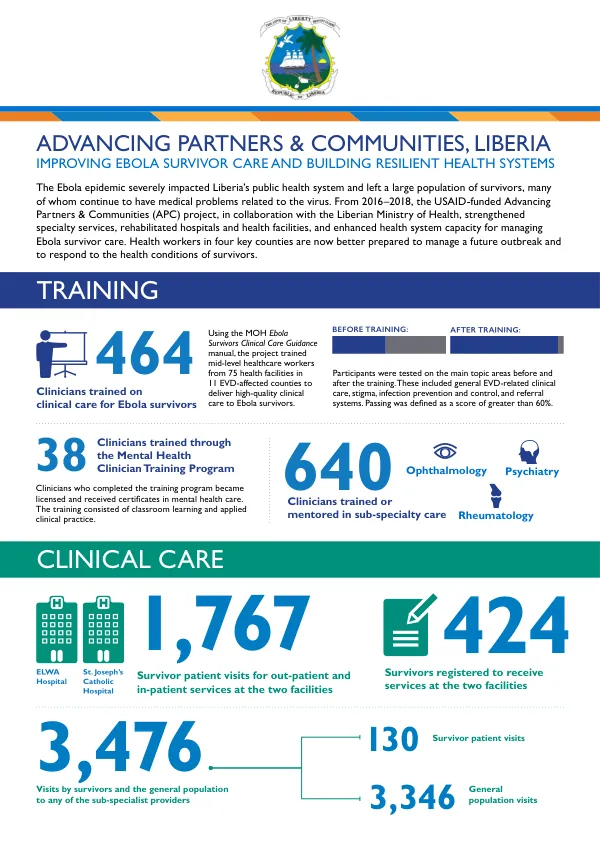
From 2016 to 2018, the USAID-funded project collaborated with the Liberian Ministry of Health to strengthen specialty services, rehabilitate hospitals and health facilities, and enhance health system capacity for managing Ebola survivor care. The project focused on four key counties, where health workers are now better prepared to manage a future outbreak and respond to the health conditions of survivors. Training was a critical component of the project, with 464 mid-level healthcare workers from 75 health facilities in 11 EVD-affected counties receiving training on Ebola survivor clinical care. Before training, only 47% of participants passed a test on the main topic areas, but after training, 95% passed. The training consisted of classroom learning and applied clinical practice, with clinicians becoming licensed and receiving certificates in mental health care. Sub-specialty care training was also provided in areas such as ophthalmology, psychiatry, and rheumatology. Clinical care for Ebola survivors was a key focus of the project, with 3,476 survivor patient visits recorded at two facilities, ELWA Hospital and St. Joseph's Hospital. The facilities provided in-patient and out-patient services, with survivors reporting respectful communication by staff during their last visit. Exit interviews with 42 randomly sampled survivors revealed that 95% would recommend the facility to friends and family. The project also measured the effects of program interventions through baseline and endline assessments with a representative sample of 676 EVD survivors. The assessments revealed significant improvements in survivor experience, with 8% of survivors reporting respectful communication by staff during their last visit, compared to 33% before the project. Additionally, 82% of survivors attended referral appointments, compared to 25% before the project. The project also renovated 6 facilities and provided equipment, including perimeter walls, borehole drilling, autoclaves, and ophthalmic equipment. The number of survivors who reported being stigmatized by healthcare providers decreased from 33% to 8%, and those who avoided or delayed seeking care due to fear of EVD-related stigma decreased from 25% to 10%.