USAID DEC
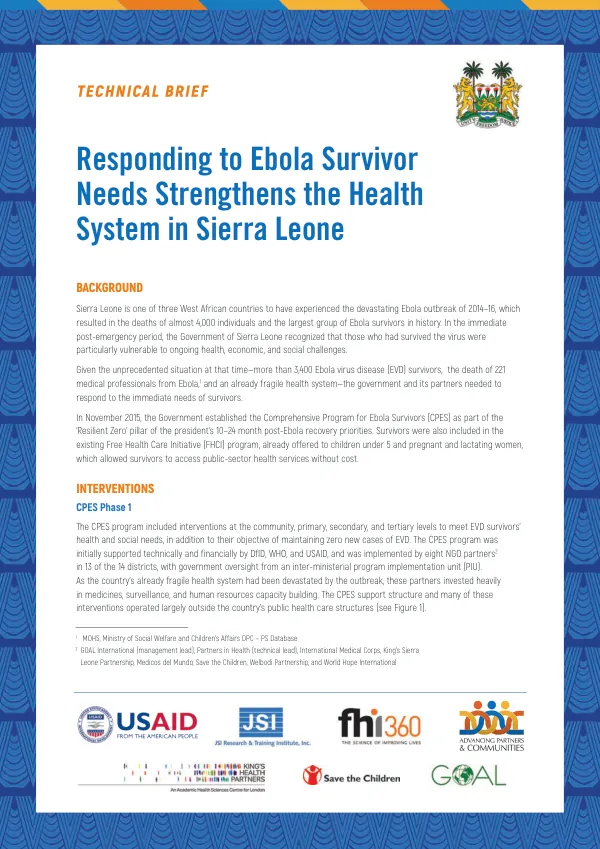
Responding to Ebola Survivor Needs Strengthens the Health System in Sierra Leone (December 2018)
Sign inFHI360
Responding to Ebola Survivor Needs Strengthens the Health System in Sierra Leone (December 2018)
The Comprehensive Program for Ebola Survivors (CPES) was established in 2015 as part of the Government of Sierra Leone's response to the Ebola outbreak.
2018 · 8 pages
Sign in to readA free account is required to download.
Abstract
The program aimed to provide support to Ebola survivors, who faced ongoing health, economic, and social challenges. The CPES program included interventions at the community, primary, and tertiary levels to address the needs of survivors. The program initially focused on providing free health care services to survivors, including medications and referrals to secondary and tertiary levels of care. However, the program's approach was later recognized as unsustainable in the long term, and it was decided to transition the program to a more integrated approach that focused on the broader Free Health Care Initiative (FHCI) population. During Phase 2 of the CPES program, the Ministry of Health and Sanitation (MOHS) took the lead in managing the program, and the program's focus shifted to supporting the entire FHCI population. The program also prioritized the integration of survivor care into the existing health sector structures, particularly at the district level. The program's success was measured by the number of referrals and visits conducted by Clinical Training Officers (CTOs) and Referral Coordinators (RCs). CTOs conducted almost 2,000 visits to primary health units across the country, covering topics such as maternal health, assessment, and EVD survivor care. RCs recorded more than 12,000 referrals, with pregnant and lactating mothers being the FHCI groups with the highest number of referrals. The program's transition to a more integrated approach has strengthened the health system in Sierra Leone, and it has provided a model for other countries to follow in responding to similar public health crises. The program's success has also highlighted the importance of community-based interventions and the need for a more sustainable approach to addressing the needs of survivors. The program's impact has been significant, with the number of referrals and visits conducted by CTOs and RCs indicating a strong response to the needs of the FHCI population. The program's focus on data-driven decision making has also provided valuable insights into the effectiveness of the program and the need for continued support. The program's success has also led to the integration of survivor care into the existing health sector structures, particularly at the district level. This has provided a model for other countries to follow in responding to similar public health crises. The program's transition to a more integrated approach has also highlighted the importance of community-based interventions and the need for a more sustainable approach to addressing the needs of survivors. The program's success has also provided valuable insights into the effectiveness of the program and the need for continued support. The program's impact has been significant