MART PROJECT
Advancing Youth-Responsive Health Systems and Services
The Evidence to Action (E2A) Project is USAID's global flagship for strengthening family planning and reproductive health service delivery.
2019 · 2 pages
Sign in to readA free account is required to download.
Abstract
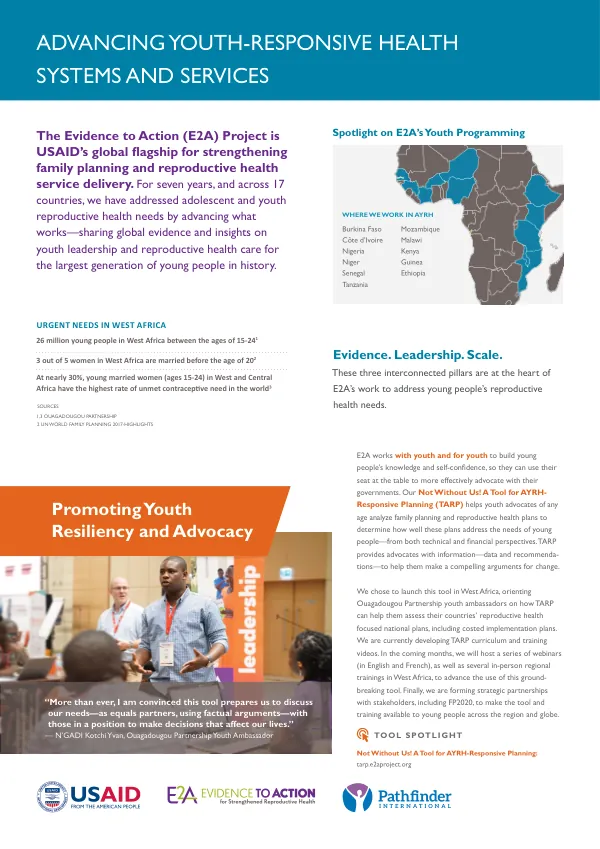
For seven years, and across 17 countries, E2A has addressed adolescent and youth reproductive health needs by advancing what works—sharing global evidence and insights on youth leadership and reproductive health care for the largest generation of young people in history. E2A works with youth and for youth to build young people's knowledge and self-confidence, so they can use their seat at the table to more effectively advocate with their governments. E2A's Not Without Us! A Tool for AYRH-Responsive Planning (TARP) helps youth advocates of any age analyze family planning and reproductive health plans to determine how well these plans address the needs of young people—from both technical and financial perspectives. TARP provides advocates with information—data and recommendations—to help them make a compelling argument for change. The tool was launched in West Africa, orienting Ouagadougou Partnership youth ambassadors on how TARP can help them assess their countries' reproductive health-focused national plans, including costed implementation plans. E2A's work is guided by three interconnected pillars: Evidence, Leadership, and Scale. These pillars are at the heart of E2A's efforts to address young people's reproductive health needs. In West Africa, there is an urgent need to address the reproductive health needs of 26 million young people between the ages of 15-24. Three out of five women in West Africa are married before the age of 20, and young married women (ages 15-24) in West and Central Africa have the highest rate of unmet contraceptive need in the world. E2A's youth programming focuses on engaging young people as leaders and promoting their resiliency and advocacy. The organization's First-Time Parent (FTP) Framework applies a life-course and socio-ecological lens to highlight the diverse characteristics and social and cultural contexts of young parents, as well as their evolving health needs throughout and beyond the FTP lifestage. Through a peer approach, E2A educates young FTPs on positive reproductive health outcomes by creating a comfortable space for them, as well as their families and social networks, to discuss, share, and learn. In Niger, E2A reached 8,000 young people in university and community settings through its comprehensive behavior-change and reproductive health project. The University Leadership for Change project supported peer leaders at Niamey's Abdou Maimouni University to examine social and gender norms and improve reproductive health knowledge and attitudes among students. The program also expanded access to youth-friendly services at the university health center and in the surrounding community health facilities. Building off the success of this project, peer leaders established an independent student-led association to ensure the sustainability of the program's approach.
Related documents