GOVERNMENT OF SENEGAL
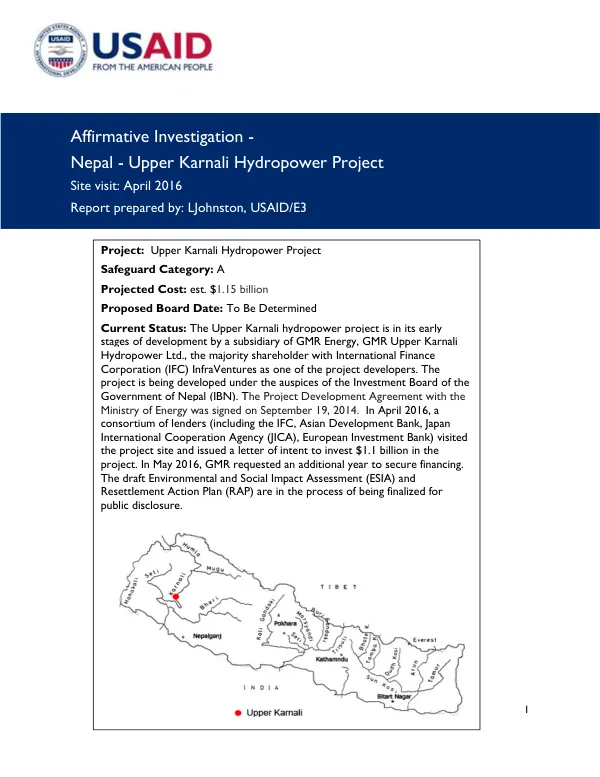
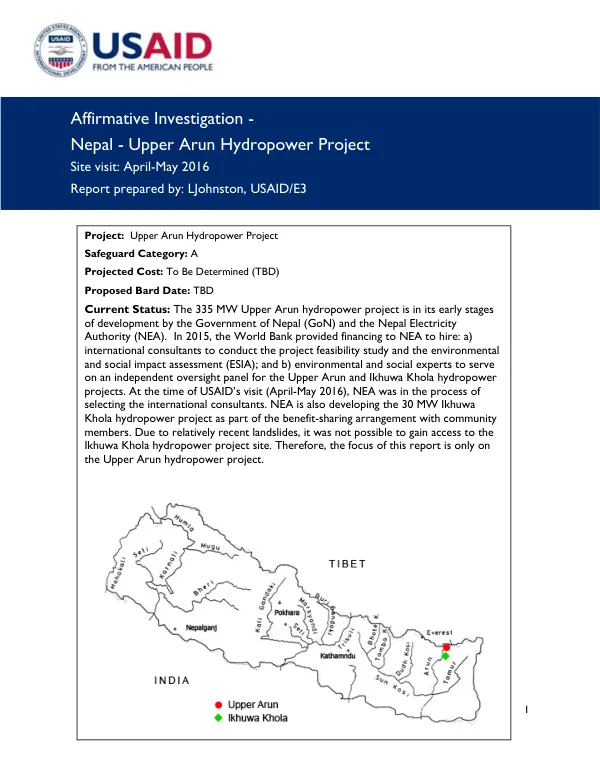
Affirmative Investigation - Nepal - Upper Arun Hydropower Project
The Upper Arun Hydropower Project is a 335 MW project being developed by the Government of Nepal (GoN) and the Nepal Electricity Authority (NEA).
2016 · 29 pages
Sign in to readA free account is required to download.
Abstract
The project is in its early stages of development, with the World Bank providing financing in 2015 to hire international consultants to conduct the project feasibility study and environmental and social impact assessment (ESIA). At the time of the USAID visit in April-May 2016, NEA was in the process of selecting the international consultants. The project area is home to several indigenous peoples, including the Tamang, Gurung, Rai, and Bhodi, who live in remote areas with limited development opportunities and limited government support. The communities are primarily subsistence-based, with livelihoods centered on agriculture and livestock. Recently, some communities have expanded cardamom production for sale, which has contributed to improved livelihoods. Community members are supportive of the national strategic road, which will connect Nepal to India and China, and will provide access to the Upper Arun project area. However, many communities above Hatiya village were unaware or had limited knowledge of the Upper Arun hydropower project. Those who were aware viewed the project as a means for providing development opportunities, but many of the project's benefits will likely be years in the future. Project-affected community households will be provided with financial compensation and the option to acquire project shares in the Ikhuwa Khola hydropower project as part of the benefit-sharing arrangements. Additionally, electricity generated by the Ikhuwa Khola hydropower project will be provided to the project-affected communities. Community members reported changes in the environment, including an increase in the flow of the Arun River, which they attributed to rapid snow melt. They also reported increased deforestation due to home construction and continued reliance on wood fires, as well as increased prevalence of mosquitoes and several springs drying up. Based on the project area site visits, stakeholder discussions, and available documentation, USAID proposes the following environmental and social recommendations for the Upper Arun Hydropower Project. The first recommendation is to institute an interim development program for project-affected communities as soon as feasible. This program would aim to enhance livelihoods through support for education, health services, and market access improvements. The second recommendation is to ensure effective communication and realistic information provided to project-affected communities on the timeline for project development. This would involve providing regular updates on the project's progress and timeline, as well as ensuring that communities are aware of the benefits and risks associated with the project. The third recommendation is to conduct a comprehensive environmental and social impact assessment (ESIA) for the Upper Arun hydropower project, including a detailed assessment of the potential impacts on indigenous peoples, the environment, and local communities. This assessment would provide a comprehensive understanding of the project's potential impacts and inform the development of mitigation measures. The fourth recommendation is to develop a comprehensive resettlement plan for project-affected communities, including a detailed plan for compensation, relocation, and rehabilitation. This plan would ensure that communities are adequately prepared for the impacts of the project and that their rights and interests are protected. The fifth recommendation is to establish a grievance redressal mechanism for project-affected communities, which would provide a channel for communities to raise concerns and grievances related to the project. This mechanism would ensure that communities have a voice in the project's development and that their concerns are addressed in a timely and effective manner. Overall, the Upper Arun Hydropower Project has the potential to provide significant benefits to Nepal, including increased electricity generation and economic growth. However, it is essential that the project is developed in a responsible and sustainable manner, with adequate consideration for the potential impacts on indigenous peoples, the environment, and local communities.
Related documents