GOVERNMENT OF SENEGAL
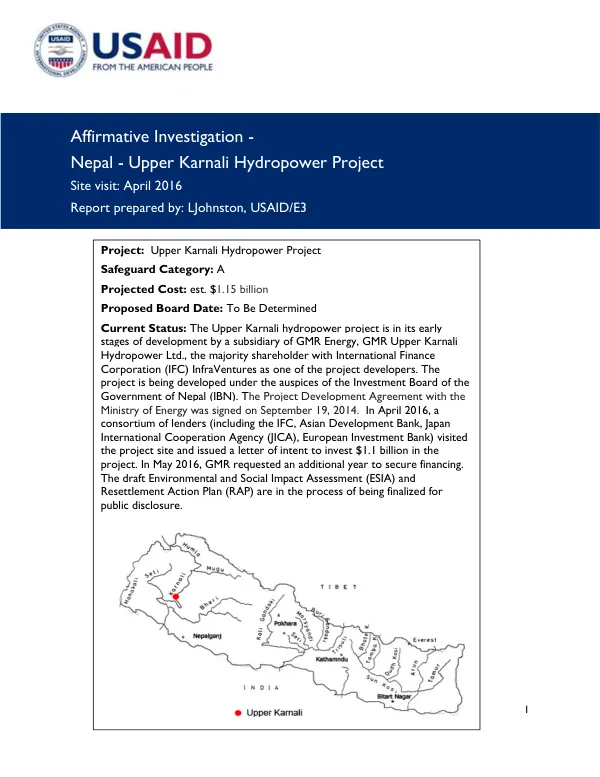
Affirmative Investigation - Nepal - Upper Karnali Hydropower Project
The Upper Karnali Hydropower Project in Nepal is a major development initiative aimed at providing energy and economic opportunities to the districts and communities in the region.
2016 · 21 pages
Sign in to readA free account is required to download.
Abstract
The project is being developed by GMR Upper Karnali Hydropower Ltd., a subsidiary of GMR Energy, in collaboration with the Investment Board of the Government of Nepal (IBN) and International Finance Corporation (IFC) InfraVentures. The project has received strong political and community support, with widespread backing from the Government of Nepal and local communities. However, the project's development has been marred by delays, which have created high levels of stakeholder anxiety and suspicion of the Government of Nepal, IBN, and GMR. The lack of adequate information and effective communication between IBN, GMR, and project-affected communities has resulted in unrealistic expectations about the project timeline. This has led to concerns over the scope of the project's Environmental and Social Impact Assessment (ESIA) and mitigation measures, as well as the ability or commitment of the project sponsor or Government of Nepal to implement these measures. The project's benefits, including employment, economic opportunities, and social services, are likely to be years in the future, given that compensation and associated development activities cannot commence until the project reaches financial closure. Project-affected districts will not begin to receive additional support through royalties until after the project begins operations. This delay has broadly restricted investment, development programs, and economic growth while communities and local government wait in limbo for the benefits of the hydropower project to materialize. The USAID-led affirmative investigation team has proposed several environmental and social recommendations for the Upper Karnali Hydropower Project. These recommendations include the establishment of an interim development program for project-affected communities, improvement of communication and provision of realistic information to stakeholders on the timeline for project development, and analysis of the differential impacts of when and how project-affected communities acquire project shares. The interim development program would aim to more immediately enhance livelihoods in project-affected communities by supporting the education system, providing health services and electricity, and improving market access through transportation improvements. This program would be implemented as soon as feasible and, at the latest, within one year of signing the Memorandum of Understanding between the Government of Nepal and the project sponsor. Improving communication and providing realistic information to stakeholders on the timeline for project development is also crucial. Despite the outreach that GMR has done to date, there are still significant gaps in communication with communities. An IBN information officer stationed in the project area would assist in providing timely information and addressing the critical importance of communities understanding the complexities of developing a hydropower project of this size. The differential impacts of when and how project-affected communities acquire project shares also require analysis. Research has suggested that the economic value of project shares can vary significantly depending on the timing and manner of acquisition. This analysis would help to ensure that project-affected communities are fairly compensated and that the project's benefits are equitably distributed. Overall, the Upper Karnali Hydropower Project has the potential to provide significant benefits to the districts and communities in the region. However, the project's development has been hindered by delays and a lack of effective communication. The proposed recommendations aim to address these issues and ensure that the project is developed in a way that is environmentally and socially sustainable.
Related documents
Documents in this collection
 2016
2016USAID DEC
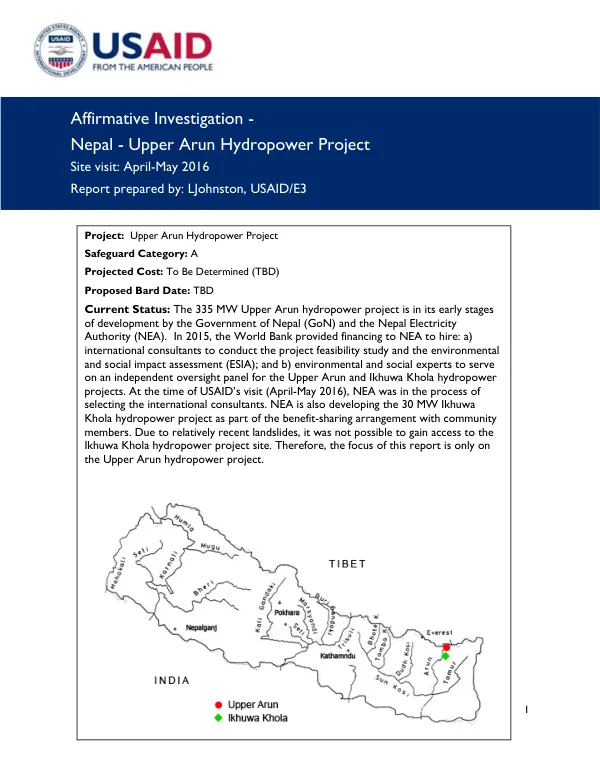
Affirmative Investigation - Nepal - Upper Arun Hydropower Project
Open record![Changes in Service Availability, Readiness, Process of Care, and Caregiver Satisfaction with Child Curative Services: A Comparison between the 2015 and 2021 Nepal Health Facility Surveys (FA146) - Analysis Brief [AB39]](https://covers.devme.ai/gen/145170.webp) 2024
2024USAID DEC
![Changes in Service Availability, Readiness, Process of Care, and Client Satisfaction with Family Planning Services: A Comparison between the 2015 and 2021 Nepal Health Facility Surveys (FA147) - Analysis Brief [AB41]](https://covers.devme.ai/gen/138852.webp)