USAID DEC
Final Consultant’s Report: Expert Training on System Scale Planning Products and Tools
Sign inDAI GLOBAL, LLC
Final Consultant’s Report: Expert Training on System Scale Planning Products and Tools
The Paani Program, sponsored by USAID-Nepal, aimed to provide expert training on system-scale planning products and tools.
2021 · 21 pages
Sign in to readA free account is required to download.
Abstract
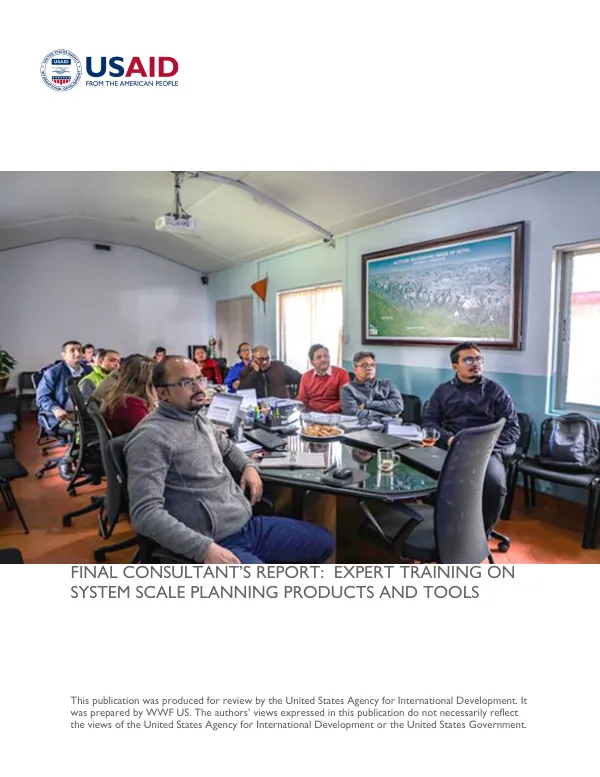
The program was implemented by DAI Global, LLC, with WWF-US as the sub-contractor. The training was conducted over a period of four weeks, with a total of 64 individuals participating in at least one session and 12 participants attending all 12 days of training. The training focused on three key areas: High Conservation Value (HCV) Rivers, System-scale Planning (SSP), and energy options assessment. The training materials were developed in collaboration with WWF-US and consultants, and included a handbook, annotated slides, frequently asked questions and answers, links to case studies and relevant literature, and recordings of the sessions. The training sessions were facilitated by experts from Confluvio, University of California-Berkeley, and WWF-US. The training materials were compiled into a handbook that included annotated slides, frequently asked questions and answers, links to case studies and relevant literature, and recordings of the sessions. Two tools were developed during the training: the System-scale Planning (SSP) map package and the updated High Conservation Value Rivers (HCVR) tool. The SSP map package was created in QGIS, allowing data accessibility to users who do not have ArcGIS licenses. The HCVR tool was extended to include information on SSP, and was hosted through the Paani-Central Department of Environmental Science, Tribhuvan University (CDES-TU) Freshwater Center of Excellence platform. Recommendations were made for future development of the tools, including the creation of a separate Cascading Style Sheet for the main and map page, and making the website as responsive as possible. Additionally, it was recommended to limit the display of hydropower project location to a coarse zoom level, and to further minimize the file hcvr_minified.js by shortening variable names or serializing the data. The training filled a niche in providing an in-depth review and understanding of the materials produced during the Paani project. The site was updated to include an introductory sequence/tour for new users, and the training materials were made available for future reference. The training was successful in providing practitioners and policy and decision makers in Nepal with the knowledge and skills necessary to apply system-scale planning and HCV concepts in their work. The training was conducted in a collaborative manner, with WWF-Nepal working with DAI staff to identify a preliminary list of invitees and develop a flyer outlining the objectives and content of the program. The training was well-received by participants, who appreciated the opportunity to learn from experts and share their own knowledge and experiences. The Paani Program's expert training on system-scale planning products and tools has provided a valuable resource for practitioners and policy and decision makers in Nepal. The training materials and tools developed during the training will continue to be useful in the future, and the program's success demonstrates the importance of providing training and capacity-building opportunities for those working in the field of system-scale planning and HCV conservation.