USAID DEC
Afghan Civic Engagement Program (ACEP) - Counterpart Value: $79,120,000 Duration: December 2013 to December 2019
Sign inAGA KHAN FOUNDATION
Afghan Civic Engagement Program (ACEP) - Counterpart Value: $79,120,000 Duration: December 2013 to December 2019
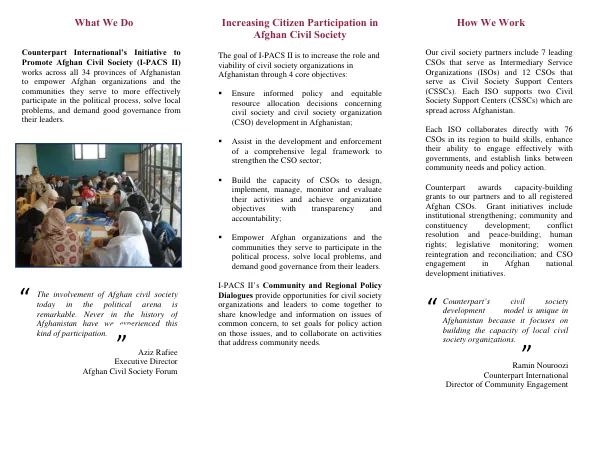
The Afghan Civic Engagement Program (ACEP) was a five-year initiative implemented by Counterpart International, in partnership with Internews Network, the International Center for Not-for-Profit Law (ICNL), and the Aga Khan Foundation (AKF).
2013 · 7 pages
Sign in to readA free account is required to download.
Abstract
The program aimed to enable Afghan citizens to influence policy, monitor government accountability, and serve as advocates for political reform through civil society development and media engagement. With a budget of $79,120,000, the program was funded by the United States Agency for International Development (USAID) from December 2013 to December 2019. The program focused on five key areas: regular civil society organization (CSO) engagement with government, increased CSO and media thematic expertise in democracy and governance, expanded civic engagement, improved access to independent news and public affairs information, and increased CSO organizational capacity. In June 2018, the program was extended for an additional year to focus on expanding civic and voter education during the October 2018 parliamentary elections and the 2019 presidential election. Through 34 provincial CSO partners and seven regional CSO partners, the program conducted community civic and voter education sessions in 28 provinces, reaching a total of 420,156 participants, including 207,977 women and 212,179 men. Community dialogues resulted in commitments from the government to build a hospital, install electricity power lines, and support the construction of a girls' school. The program also trained 64,678 individuals on institutional development, civic engagement, project cycle management, policy dialogue, and partnerships. The Civil Society Election Coordination Group (CECG) developed into an inclusive platform for elections-focused CSOs to discuss and address challenges with electoral management bodies. The CECG held eight meetings since 2017 and strengthened civil society's level of communication with the electoral management bodies. The Civil Society Joint Working Group (CSJWG) expanded its membership by 160 CSOs from ten northern and southern provinces, resulting in the opening of two regional hubs in Mazar-e-Sharif and Kandahar. The CSJWG presented position papers at national and international donor conferences and supported the network's expansion into seven regional hubs to bridge the rural-urban gap. The advocacy group on the National Budget submitted recommendations to the Parliamentary Budget Commission, which resulted in the approval of six out of 17 recommendations. The group also developed recommendations to amend the Cybercrime Law from a women's rights perspective, which the government committed to implement. The Emerging Civil Society Leaders (ECSL) program enrolled 136 male and female youth, who were supported through trainings, networking events, and study tours to increase their collective and individual roles in elections, peace efforts, and civil society development. The ECSL program produced globally-minded and politically-active leaders, including one ECSL who became the first-ever youth to speak at the United Nations Security Council and another who became a recipient of the One Young World Scholarship Program. The program's achievements included the successful election of six ECSLs, including two women, to Parliament, and the convening of a broad range of civil society actors to discuss key issues. Overall, the ACEP program aimed to strengthen civil society in Afghanistan and promote democratic values, good governance, and human rights.
Related documents