AFGHANISTAN MINISTRY OF AGRICULTURE, IRRIGATION AND LIVESTOCK
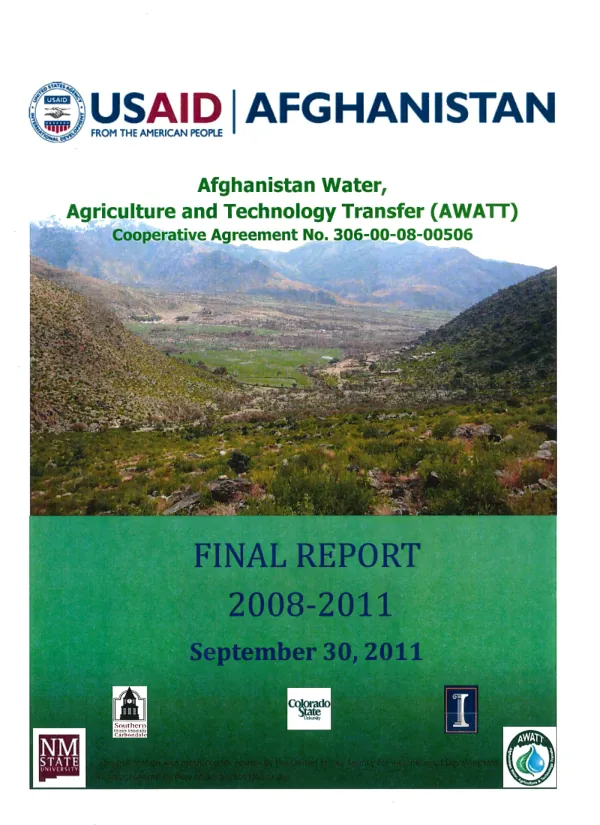
Afghanistan Water, Agriculture and Technology Transfer (AWATT) Final Report
The Afghanistan Water, Agriculture and Technology Transfer (AWATT) program was a cooperative agreement between the United States Agency for International Development (USAID) and a consortium of four universities, including New Mexico State University, Colorado State University, University of Illinois at Urbana-Champaign, and Southern Illinois University at Carbondale.
2011 · 52 pages
Sign in to readA free account is required to download.
Abstract
The program aimed to increase agricultural output, create agricultural-sector jobs and incomes, and increase confidence in the Afghan government. AWATT's activities were implemented in more than three-fourths of Afghanistan's provinces, including Taliban-sympathetic areas and non-Taliban regions. AWATT introduced water management practices and agricultural technologies that increased agricultural output per unit of land by 50% or more and increased the area of cultivatable land by nearly 9,000 hectares. The program created direct employment for 2,500 temporary full-time equivalent jobs and resulted in increasing cultivatable land area, which created employment potential for 134,000 additional permanent farm jobs. AWATT provided training opportunities for more than 6,600 individuals, including over 500 Ministry of Agriculture, Irrigation and Livestock (MAIL) staff and 330 women. The program's original main objective was to increase opportunities for Afghans to access information and knowledge on appropriate technology, provide tools and mechanisms for policy and institutional changes, and enhance the management of water resources and development of a legislative framework for tenure and rights of private and common land in rural areas. However, following changes in U.S. Government strategy and at the request of USAID in response to GIRoA ministry concerns and the Afghan First policy, the program's final objective was modified to improve community and farm-level management of the supply and demand of irrigation water resources, with the overall goal of increasing agricultural productivity and food security in Afghanistan. AWATT pursued the implementation of three program components: Integrated Water Management, Appropriate Agricultural Technology, and Technical Assistance to MAIL. The Integrated Water Management component developed an efficient and equitable community-based irrigation water resource distribution and management system, which led to improved agricultural productivity. The Appropriate Agricultural Technology component identified and promoted the use of technologies to increase agricultural productivity and rural incomes in areas subject to seasonal drought and high risks of land degradation, deforestation, or loss of biodiversity. The Technical Assistance to MAIL component provided technical assistance to improve MAIL's irrigation and watershed management decision-making strategies and outreach capabilities. Afghanistan is an agrarian country with more than 75% of its population living in rural areas, where the economy is based on agricultural products and livestock. Water is a critical element for improving rural livelihoods, and only two to four percent of land was cultivated due to limited access to water and irrigation. AWATT recognized the importance of an integrated approach to managing land and water resources, which are viewed as complementary resources. The program addressed obstacles to increasing Afghanistan's agriculture sector productivity and output, including the lack of an integrated water basin-scale framework for analyzing land use and water policy proposals, the lack of current information on water systems, irrigation, and water supplies, and the lack of institutional capacity and facilities to train future generations of Afghans in state-of-the-art analysis, evaluation, and design of land use, water, and technology policies and programs.