AFGHANISTAN MINISTRY OF AGRICULTURE, IRRIGATION AND LIVESTOCK
Grain Research and Innovation FY18, Quarter 1 Report
The Grain Research and Innovation (GRAIN) project was conceived in response to the Government of the Islamic Republic of Afghanistan's need to build the wheat research capacity of the Ministry and Directorates of Agriculture, Irrigation and Livestock (MAIL/DAILs) and the Agricultural Research Institute of Afghanistan (ARIA).
2018 · 23 pages
Sign in to readA free account is required to download.
Abstract
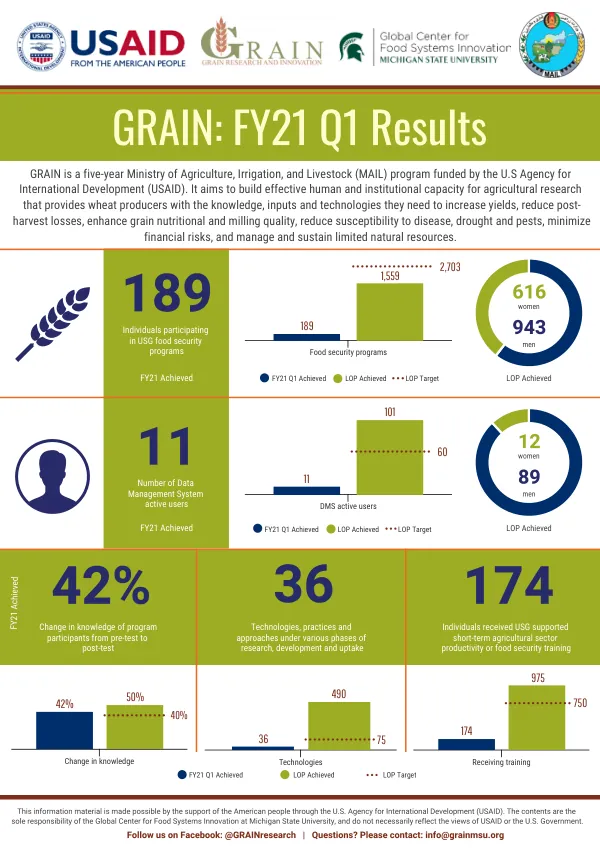
The project is being implemented by Michigan State University's (MSU) Global Center for Food Systems Innovation (GCFSI) with funding from the United States Agency for International Development (USAID). The principal objective of GRAIN is to enhance the capacity of Afghanistan's Ministry of Agriculture, Irrigation, and Livestock to conduct wheat-related research and to identify technologies and practices that promise the greatest benefits to wheat sector stakeholders in Afghanistan. The specific objectives of GRAIN are to improve the institutional and human capacity of MAIL/ARIA to conduct wheat research, and to analyze and communicate the findings, in collaboration with key stakeholders. Additionally, GRAIN aims to improve the institutional and human capacity of MAIL/ARIA to convert research results into recommended best practices for wheat producers in different agro-ecological zones. Furthermore, the project seeks to strengthen the capacity of the public and private sectors to identify and address key constraints to wheat production in Afghanistan. Implementation of GRAIN began on March 29, 2017, and is scheduled to conclude on September 30, 2022. The project is being implemented in accordance with an annual work plan, which outlines key activities and milestones. The work plan is divided into several components, including human capacity development, institutional capacity building, and project management. Human capacity development is a key component of GRAIN, with a focus on building the skills and knowledge of MAIL/ARIA staff in areas such as wheat research, data management, and laboratory techniques. This is being achieved through a range of training programs, including short-term technical training, long-term degree training, and small grants programs. Additionally, GRAIN is providing support for the creation of locally adapted procedures for the implementation of wheat production trials, as well as the provision of hardware and software to support the design, implementation, and analysis of wheat production trials. Institutional capacity building is also a key component of GRAIN, with a focus on strengthening the capacity of MAIL/ARIA to conduct wheat research and to communicate the findings to stakeholders. This is being achieved through a range of activities, including the development of research data management systems, the improvement of laboratory equipment and facilities, and the provision of support for the implementation of wheat variety trials and best practice demonstrations. Project management is also a critical component of GRAIN, with a focus on ensuring that the project is implemented in a timely and efficient manner. This is being achieved through a range of activities, including monitoring and evaluation, learning and adaptation, communication and outreach, and partner and stakeholder collaboration.
Related documents