AFGHANISTAN MINISTRY OF AGRICULTURE, IRRIGATION AND LIVESTOCK
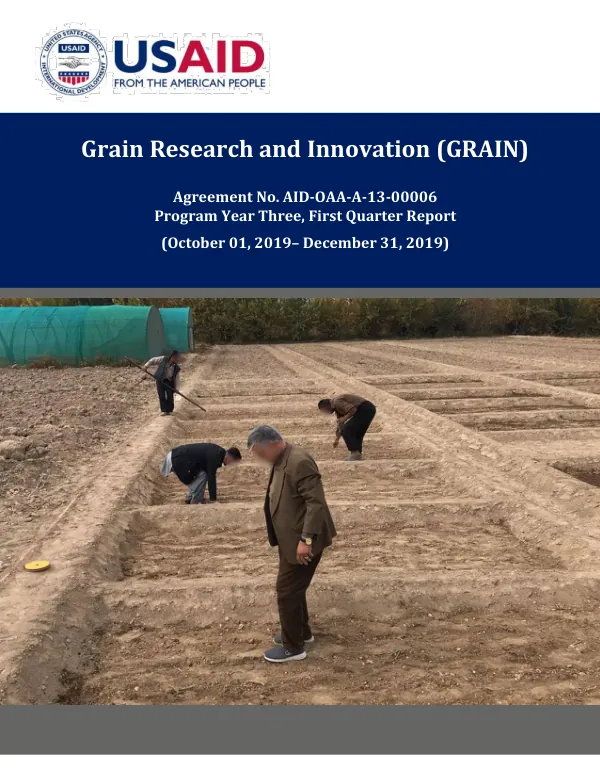
Program Year Three, First Quarter Report (January 01, 2020– March 31, 2020)
The Grain Research and Innovation (GRAIN) project was conceived in response to the Government of the Islamic Republic of Afghanistan's need to build the wheat research capacity of the Ministry of Agriculture, Irrigation and Livestock (MAIL) and Provincial Directorates of Agriculture, Irrigation and Livestock (DAILs) and the Agricultural Research Institute of Afghanistan (ARIA).
2020 · 40 pages
Sign in to readA free account is required to download.
Abstract
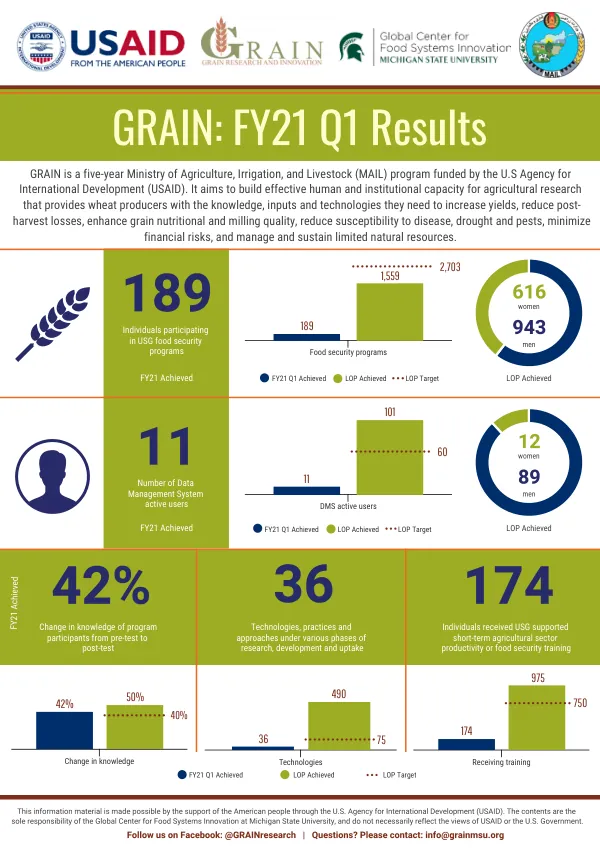
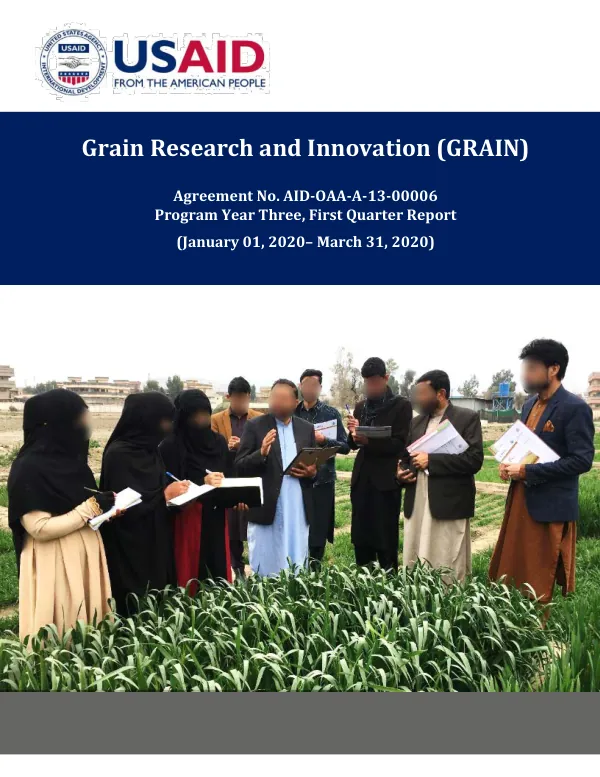
The USAID-funded project is being implemented by Michigan State University's Global Center for Food Systems Innovation (GCFSI), and channeled as a buy-in from USAID/Afghanistan through the Higher Education Solutions Network (HESN) of USAID's Global Development Lab. The project period is March 29, 2017, through September 30, 2022. The principal objective of GRAIN is to enhance the performance of Afghanistan's Ministry of Agriculture, Irrigation and Livestock in filling its mandate to lead responsive research to identify and disseminate technologies and practices that promise the greatest benefits to wheat sector stakeholders in Afghanistan. Emphasis on building the capacity of and creating opportunities for women in agricultural research and improving the gender-responsiveness of research and subsequent extension messaging in the wheat sector is integrated throughout program activities. Specific goals are to improve the capacity of MAIL/ARIA to conduct wheat research, interpret and share research findings, and translate research results into recommended best practices for wheat sector stakeholders in different agro-ecological regions. This quarter marked significant accomplishments led by the GRAIN team with partners at ARIA and partner Afghan Universities. A total of 190 participants were involved in GRAIN programs, including 108 individuals participating in short-term training programs and 123 participating in programming related to women's empowerment in agricultural sectors. Recognizing Women Innovators in Agriculture was a notable event, with workshops held in Balkh, Kabul, and Nangarhar Provinces to highlight women's contributions to agricultural innovation in Afghanistan and around the world. The GRAIN project has implemented several key activities to achieve its objectives. These include sponsorship of long-term degree training in fields relevant to wheat research, facilitation of short-term training for wheat research, creation of locally adapted procedures for implementation of field and lab research, and implementation of field and lab research, including gender-responsive research. Additionally, the project has facilitated the ARIA Research Internship Program, implemented the Women in Agricultural Research Mentorship Program, and supported the sustainable operations of current or new ARIA research lab and field facilities. The project has also made significant progress in improving the capacity of MAIL/ARIA to interpret and share research findings and to translate research results into recommended best practices for wheat sector stakeholders in different agro-ecological regions. This has been achieved through the facilitation of research conferences and workshops, short-term training on presenting and publishing research results, and the development of region-specific packages of best practice recommendations. Furthermore, the project has strengthened collaboration between MAIL research units, public extension systems, and private sector stakeholders along with the wheat value chain. This has been achieved through the facilitation of work groups between ARIA, extension, universities, and private sector stakeholders, participation in and facilitation of stakeholder conferences and workshops, and the implementation of small grants research program for collaborative research. The project has also made significant progress in improving the knowledge and skills of wheat researchers and extension staff to recognize gender roles in the wheat value chain and develop research priorities that are gender-responsive. This has been achieved through gender mapping in the wheat value chain, assessing research for gender-responsiveness, and training on gender-responsive research design and implementation. Overall, the GRAIN project has made significant progress in achieving its objectives and improving the capacity of MAIL/ARIA to conduct wheat research, interpret and share research findings, and translate research results into recommended best practices for wheat sector stakeholders in different agro-ecological regions.