ABT. GLOBAL
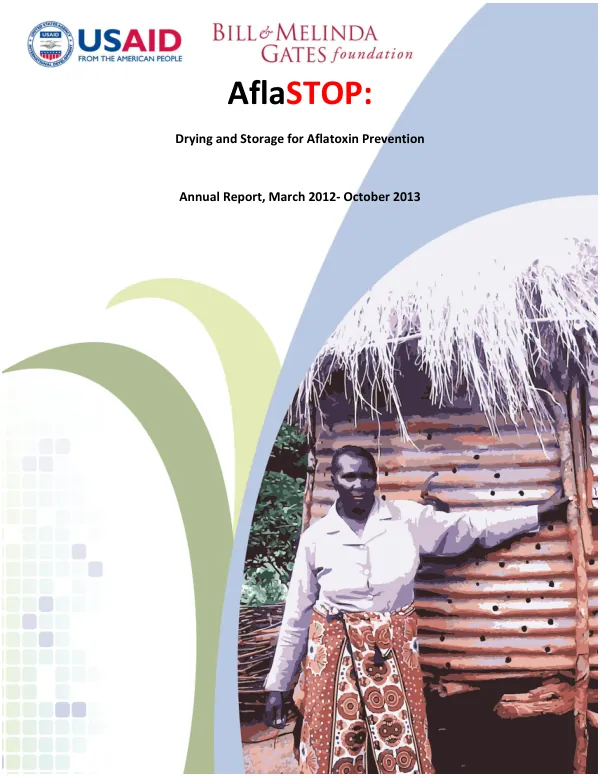
AflaSTOP Annual Report 2012-2013
AflaSTOP is a project aimed at developing and commercializing technologies for post-harvest storage and drying of staple grains to prevent and control aflatoxin contamination.
2013 · 6 pages
Sign in to readA free account is required to download.
Abstract
The project focuses on identifying and marketing existing, commercially viable, small-scale storage and developing new low-cost drying technology that can be affordable to farmers as an investment or as a service. The project's ultimate goal is to reduce aflatoxin contamination at the farm level, improve crop handling and management practices, and increase the nutritional value of crops consumed by smallholders. Initial assessments conducted by AflaSTOP identified soil degradation and limited market access as primary challenges faced by smallholder farmers in Kenya. The project aimed to undertake a number of assessments to better understand how farmers prepare grain for storage, how storage is used, and the economic costs of storage choices. AflaSTOP completed several major studies on aflatoxin storage and drying, including the North Rift and Eastern Province Storage Surveys, which interviewed 50 smallholder farmers in North Rift and 48 farmers in Eastern Province to establish practice and attitude towards storage of main commodities. The project also conducted a Kenyan Storage Practice Survey, which compared storage practices in the North Rift, Meru, Makueni, and Eastern Province. The survey identified types of existing storage, common pests, insecticide use, and mold prevalence. Additionally, AflaSTOP rented 6 stores in Makueni, Eastern Province for off-farm testing of storage technology and procured 11 metric tons of maize for storage and testing. AflaSTOP aimed to identify commercially viable drying technology suitable for smallholder farmers through desk research and field surveys. The project commissioned a survey to investigate maize drying practices in Rift Valley Province (North Rift) among 48 farmers in January 2013. The North Rift Drying Survey was carried out after the long rains harvest in November/December 2012, and the information collected will help inform the contractor working on developing appropriate drying technology for smallholder farmers. The project also issued a request for proposals (RFP) to identify a consultant Research, Design and Development (RD&D) team to support the project in identifying commercially viable drying technology. Catapult Design was identified as the best potential service provider to deliver commercially oriented drying technology for smallholder farmers. The project team put together criteria to consider the cost effectiveness and the technical content of each bid, and all proposals were reviewed by two teams. AflaSTOP has also contributed to a collection of policy briefs on Aflatoxins: Finding Market and Technology Solutions to Improve Food Safety for IFPRI and its 2020 Vision Initiative. The brief on Aflatoxin in Kenya: Farmers' Perceptions, Strategies, and Implications for Intervention is based on findings in the storage and drying surveys. The project has also facilitated AFRICOM's pilot project, attended PACA and other aflatoxin events, and developed and maintained connections with others working on storage, drying, and aflatoxin control in Africa. The project's goals were not met due to delays in testing storage technologies, which were agreed upon by the AflaSTOP Global Development Alliance (GDA) Partners in November 2012. The Partners agreed to delay the testing until August 2013 to amend the Initial Environmental Evaluation and conduct consultations with key Kenyan stakeholders. The IEE Amendment documentation was modified to reflect this new approach, and the IEE documentation was completed and submitted to USAID, who approved the document on March 23, 2013.
Related documents