ABT. GLOBAL
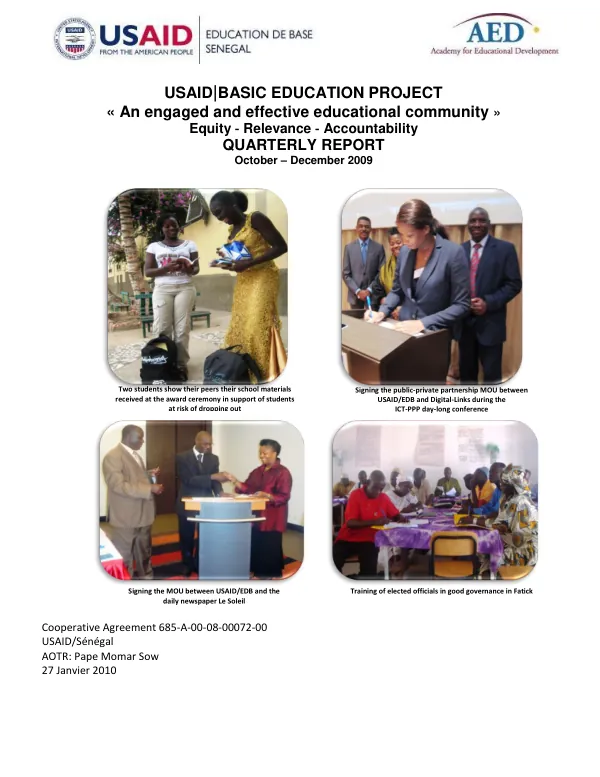
USAID|BASIC EDUCATION PROJECT Quarterly Report (October-December 2009)
The USAID/Basic Education Project in Senegal aimed to improve the quality of basic education and vocational training for vulnerable children.
2009 · 35 pages
Sign in to readA free account is required to download.
Abstract
The project's overall goal was to provide vulnerable children with a quality basic education and/or vocational training, and reunite children "en rupture" with their estranged families. The project's specific objectives included advocating for the support and engagement of state authorities, local officials, and opinion leaders in protecting children's rights, improving the quality of education for vulnerable children, especially girls, and creating education strategies for talibes and street kids to facilitate their re-entry into the formal school system. During the period of October to December 2009, the project made significant progress in achieving its objectives. The business sector was successfully mobilized in support of education, with three million FCFA raised in a day-long exploration of public-private partnerships in support of the integration of technology in education. Seven memoranda of understanding were signed with businesses in high technology, journalism, and food to provide equipment and services to the project's beneficiaries. Under these agreements, talibes in the most vulnerable daaras in all ten regions of the project will receive bread daily, 11 middle schools will receive additional laptops and internet services, and the project will receive technical support in building its electronic data collection instruments. The project also provided support to 500 middle school children at risk of dropping out of school due to a lack of school supplies and mobility to travel to school. These students received materials such as books, notebooks, pencils, learning implements, backpacks, bicycles, and orthopedic shoes, enabling them to matriculate and persist through the year. Additionally, school officials were sensitized to the needs of the students and accompanied by the project to address those needs. The project's framework for the middle school curriculum revision process was produced and validated this quarter. The framework includes the need for more relevance and greater inter-disciplinarity in the subject matters taught, a pedagogy allowing students to develop skills of critical thinking and good governance, and an orientation to the world of work. The strategy for implementing this framework includes a focus on the five core subjects of the curriculum, the development of program and pedagogical guides for the subjects, and a mechanism for training teachers and implementing the revised curriculum in the schools. The regional offices of the project are fully operational with trained staff and equipment in place. Regional bank accounts were opened in the southern regions, and the integration of financial procedures between the national and regional offices was established. The recruitment of the Deputy Chief of Party was completed, and the review process was completed in early January. Sala Ba was selected from among 43 applicants and will join the team in mid-February. During the period of October to December 2009, the project made significant progress in achieving the objectives of Component 1-Vulnerable Children. The draft version of a program of elementary/secondary/professional education adapted to Talibes and other vulnerable children was tested. During the period of December 14-28 2009, 121 teachers recruited from the regions of Dakar, Louga, St. Louis, and Matam were trained, of which 91 were selected to teach the curriculum. The training occurred under the supervision of the regional coordinators and was delivered by regional trainers selected by the IA and IDEN. A total of 12,500 Talibes and other vulnerable children, including 2,250 girls, were newly registered to participate in primary, middle, secondary, and professional educational programs. This quarter, 1,198 vulnerable children, of which 400 girls, were identified and registered in educational programs. The 4,845 children identified in Year 1 were registered this quarter in educational programs. Hence, cumulatively, through the project's interventions, there are 6,043 vulnerable children (1,483 girls) who are benefiting from educational programs.