USAID
African Supply Chains: Meandering the AFCTA Maze
The African Continental Free Trade Area (AfCFTA) has been ratified by 43 of 54 African states, including the continent's three largest economies.
8 pages
Sign in to readA free account is required to download.
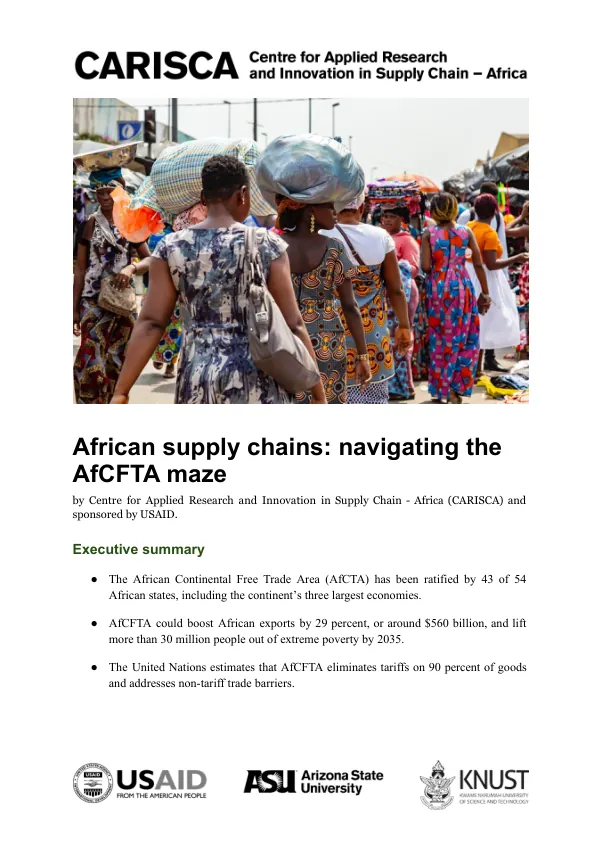
Abstract
The agreement aims to create the world's largest free trade area through a single market for goods and services for over 1.3 billion people. AfCFTA promises to boost intra-African trade and bolster regional supply chains by removing tariffs, progressively liberalizing trade in services, and addressing other non-tariff barriers. African supply chains often export natural resources and overly rely on imported goods and services. The continent's export dependence on the rest of the world ranged from 80 percent to 90 percent in 2000-2017, with intra-African trade averaging 15.2 percent during the period 2015-2017. This reliance exposes African countries to shocks in global commodity price vulnerabilities and increases the risk of economic instability. Poor infrastructure, including a lack of extensive road networks and railway lines, also hinders the delivery of goods and services. AfCFTA promises to boost intra-African business by more than 50 percent by 2040, according to the United Nations Economic Commission for Africa (UNECA). The World Bank anticipates that AfCFTA could boost Africa's intra-regional exports by 29 percent, or around $560 billion, and lift more than 30 million people out of extreme poverty by 2035. However, several challenges must be overcome to ensure maximum benefit for supply chains in Africa, including varying degrees of preparedness of member states, industrialization and infrastructure development, weak supply chains, and the risks of open borders. Historical trade routes, established in the colonial era, have contributed to the continent's trade policies being geared toward getting goods and raw materials out of the continent and not necessarily into other African countries. Border patrols tend to be stricter and tariffs higher for intra-regional trade than for inter-regional trade. Further, tax waivers are more likely granted to foreign investors, who repatriate most of their earnings, than to local African businesses. The lack of standardization in intraregional demand patterns and standards for product exchange also hinders trade. To successfully navigate the AfCFTA maze, incremental rollout of the agreement for different countries, addressing the infrastructure deficit, and developing multiple indices to capture the real-time experiences of African supply chain professionals are suggested. Research institutions have a role to play in building these indices and disseminating information across the continent. Such indices will be especially useful in policy development and decision-making.
Related documents