USAID DEC
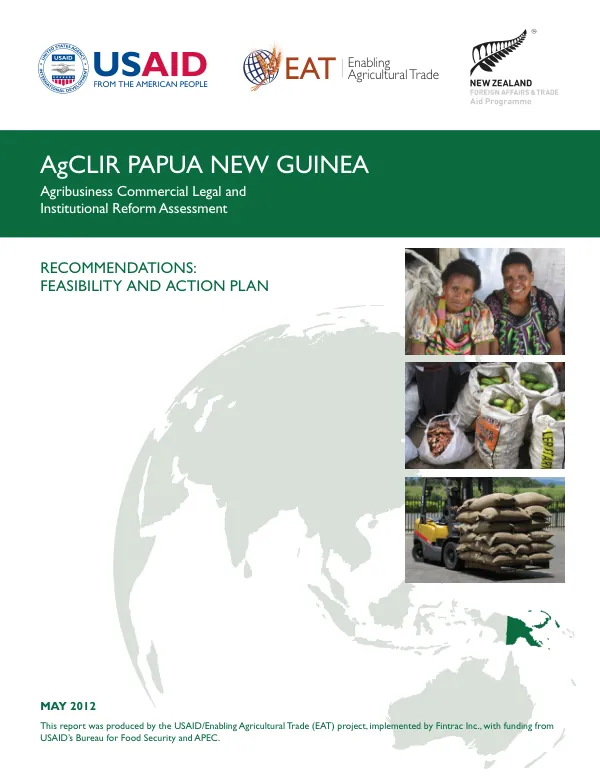
AgCLIR Papua New Guinea Agribusiness Commercial Legal and Institutional Reform Assessment
Sign inFINTRAC
AgCLIR Papua New Guinea Agribusiness Commercial Legal and Institutional Reform Assessment
The agricultural sector in Papua New Guinea is characterized by a diverse range of crops, including food crops and commodity crops.
2012 · 32 pages
Sign in to readA free account is required to download.
Abstract
The country's fertile soils, abundant rainfall, and year-round growing season make it an ideal location for agricultural production. However, the sector faces significant challenges, including limited access to land, skilled labor, and investment capital. The AgCLIR team assessed these constraints and identified proposed reforms based on successful practice and the feasibility and potential impact of the reform in the PNG context. The team found that the traditional system of social support within one's wantok network serves as a social safety net but can also act as a disincentive to individual wealth accumulation. This reduces the value to outgrower companies and drives up the risk premium, restricting access to credit throughout the agricultural sector. The wantok system also acts as the de facto basis for the rule of law, with police and judges harboring bias towards their wantok and lenders finding it difficult to enforce delinquent loans in places where the lender is considered an outsider. This drives up the cost of a loan and restricts access to credit. Cultural constraints on women in PNG also negatively affect their ability to participate in the formal agricultural sector, with women entering the sector at a distinct disadvantage. The team identified several key areas for reform, including upgrading PNG's agricultural value chains, public sector implementation and accountability, and social dynamics and economic opportunity. The recommendations include amending the Cooperative Societies (Amended) Act to allow Cooperative Societies Unit (CSU) staff to be appointed by the Department of Personnel Management, redirecting cooperative seed capital funds to finance training and marketing initiatives, and strengthening the internal auditing capacity and the external monitoring capacity of both the Investment Protection Agency (IPA) and Cooperative Societies Unit (CSU). The team also recommended strengthening the human resource capacity for SPS inspection and certification of the National Agriculture Quarantine and Inspection Authority (NAQIA), and strengthening the national laboratory capacity to allow for comprehensive testing of export products for aflatoxins and agricultural commodities. These reforms aim to improve the enabling environment for the agricultural sector and increase economic opportunities for Papua New Guineans. The recommendations made in this report will require a participatory process and dialogue among key stakeholders to undertake the reforms necessary to improve the enabling environment for the agricultural sector. Importantly, the recommendations will require unambiguous national leadership as well as a firm commitment to a reform agenda if there is any likelihood for success. Papua New Guinea's agricultural sector has the potential to expand its participation in international agricultural markets, but it faces significant challenges, including limited access to land, skilled labor, and investment capital. The AgCLIR team's recommendations aim to address these challenges and improve the enabling environment for the agricultural sector. The team's assessment of the sector's constraints and proposed reforms provide a foundation for agricultural policy development, donor intervention, and future projects. The report's recommendations are designed to be feasible and impactful, with a focus on upgrading PNG's agricultural value chains, improving public sector implementation and accountability, and addressing social dynamics and economic opportunity. The team's assessment of the sector's constraints and proposed reforms provide a foundation for agricultural policy development, donor intervention, and future projects. The report's recommendations will require a participatory process and dialogue among key stakeholders to undertake the reforms necessary to improve the enabling environment for the agricultural sector. The agricultural sector in Papua New Guinea has the potential to contribute significantly to the country's economic growth and development. However, the sector faces significant challenges, including limited access to land, skilled labor, and investment capital. The AgCLIR team's recommendations aim to address these challenges and improve the enabling environment for the agricultural sector. The team's assessment of the sector's constraints and proposed reforms provide a foundation for agricultural policy development, donor intervention, and future projects.
Related documents