USAID DEC
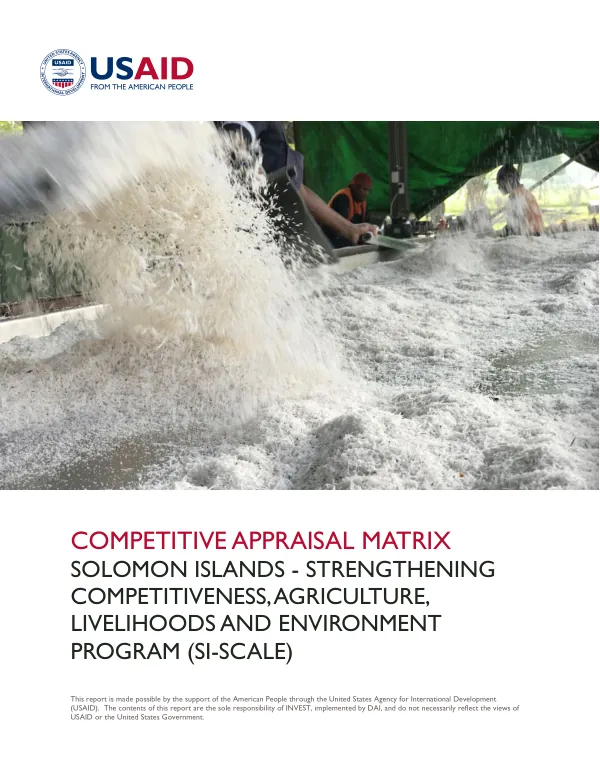
Competitive Appraisal Matrix: Solomon Islands - Strengthening Competitiveness, Agriculture, Livelihoods, and Environment Program (SI-SCALE)
Sign inDAI
Competitive Appraisal Matrix: Solomon Islands - Strengthening Competitiveness, Agriculture, Livelihoods, and Environment Program (SI-SCALE)
The Solomon Islands – Strengthening Competitiveness, Agriculture, Livelihoods, and Environment program is a comprehensive five-year project that advances economic competitiveness and inclusiveness in the agribusiness sector and improved management of the forestry sector in Solomon Islands.
2021 · 41 pages
Sign in to readA free account is required to download.
Abstract
The Market Systems and Partnerships (MSP) activity focuses on strengthening and expanding the agribusiness sector in Malaita province through co-investing in private sector partnerships. Agriculture is a vital sector for the national economy and for rural livelihoods in Solomon Islands. Agriculture products and livestock account for 85% of the rural population in Solomon Islands, with cocoa and processed oils (coconut and palm) representing the largest exports of agriculture products. The country is endowed with natural resources, consistent rainfall, and limited occurrence of cyclones, which position the agriculture sector to improve rural livelihoods across Solomon Islands, and specifically in Malaita. The assessment sought to identify where the greatest investable opportunities existed despite the steep challenges in Solomon Islands. The assessment looked to identify where resources could catalyze further development and increase incomes for smallholder farming households and other actors in the market system in Malaita. Sub-sectors that were considered needed to demonstrate consistent growth and anticipated growth potential of these markets, which could absorb increased and/or improved product from Solomon Islands, either in the domestic, regional, or international markets. The selected sub-sectors for further examination were cocoa, coconut, and kava. The cocoa industry in Solomon Islands currently makes up less than 1% of global supply, with cocoa bean exports from the Solomon Islands stable and recording between 4,400 – 4,600 MT per year grown by approximately 24,000 households (4,000 in Malaita), valued at approximately $8.94 million USD. The two significant opportunities for growth in the cocoa subsector concern increasing smallholder output volumes and improving value addition (fermenting and drying practices). The international market for the range of coconut products (copra oil, virgin coconut oil (VCO), and coconut-based cosmetic products) has shown steady overall growth over the last four years. SI exports of coconut oil have fluctuated over recent years but remain an important contributor to the rural economy. Coconut oil from the Solomon Islands is currently exported to Switzerland, the Netherlands, New Zealand, and Australia. International demand is expected to continue to grow as consumers exhibit continued and increasing preferences for use of virgin coconut oil as an alternative and healthy cooking and baking ingredient. The assessment identified that coconut has limited opportunities to expand yields based on issues related to aging trees and limited interest in investing into expanded production. However, there are good growth prospects for coconut oil exports, particularly in the international market. The assessment also noted that reliable, recent, and formal information sources were often limited, especially concerning statistics and data from Malaita.