ADVANCED ENGINEERING ASSOCIATES INTERNATIONAL, INC. /SGGA
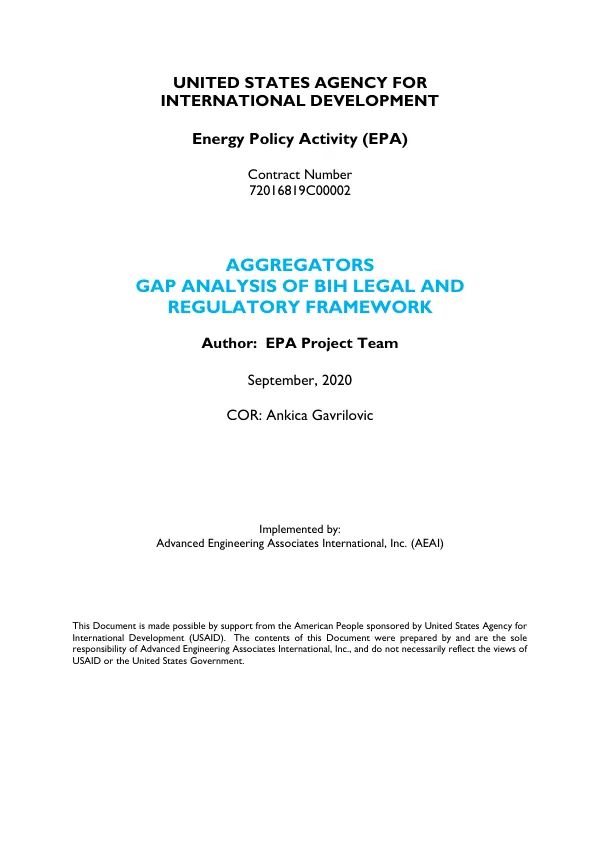
Aggregators Gap Analysis of BiH Legal and Regulatory Framework
Aggregators represent a new category of electricity market participants, which aggregate distributed energy resources (distributed generation, controllable loads, electricity storage devices), independently or through a balance responsible party, entering the electricity market and ancillary services market.
2020 · 68 pages
Sign in to readA free account is required to download.
Abstract
The emergence of aggregators in the electricity market is relatively recent and is the result of a significant increase in the proportionate share of renewable energy sources to total electricity consumption and an increase in the need for flexible resources in the power system. Aggregators bundle distributed energy resources, collectively referred to as a "virtual power plant." Both regulators and industry bodies agree that demand-side response will be a vital part of future sustainable energy systems, and that aggregators are necessary to make this possible. The concept of aggregators is included in the EU's "Clean Energy Package" and the provisions of the recent Directive (EU) 2019/944, dated June 5, 2019, on common rules for the internal market in electricity. Flexibility services in a given context are considered to be the management of the generation/consumption of distributed energy resources with the aim of providing services for the purposes of power system balancing, network management, and portfolio optimization. The regulatory framework in Bosnia and Herzegovina does not explicitly provide for the possibility of aggregating distributed energy resources for participation in the wholesale and ancillary services market. Bosnia and Herzegovina does not lag significantly behind the other Energy Community (EnC) Treaty signatories and most European Union countries, as in most of these countries, projects involving aggregation of distributed energy resources and demand-side management are at the level of research pilot projects. Significant development of the markets for distributed energy resources aggregation services has occurred in Germany, England, Norway, and several other countries with developed electricity markets. To date, legislation in the field of aggregation is not standardized and harmonized at the EU level. The primary goal of this gap analysis of the BiH regulatory framework is to review all important aspects for enabling the aggregation of distributed energy resources, the regulation of which will enable the level playing field for aggregators to participate in the electricity and ancillary services markets. The level playing field for the aggregators' market participation means non-discriminatory treatment in relation to conventional market participants in terms of participation rights and conditions, rules for the activation of contracted services, and the valuation of delivered capacity and energy. This document lists and discusses the relevant provisions of applicable regulations in BiH, primarily the Market Rules, related Procedures for Ancillary Services, and the BiH Grid Code, according to the relevance of specific provisions in relation to the reviewed aspects of the required nondiscriminatory treatment of aggregators. Regardless of the lack of an EU standard regulatory framework for the integration of aggregators, Annex 2 provides additional explanations on the different aggregator implementation models. The analysis aims to identify gaps in the current regulatory framework and provide recommendations for amendments to ensure a level playing field for aggregators in the electricity and ancillary services markets. The regulatory framework in BiH does not explicitly provide for the possibility of aggregating distributed energy resources for participation in the wholesale and ancillary services market. However, the Market Rules and related Procedures for Ancillary Services contain provisions that could be interpreted as allowing for the participation of aggregators in the electricity market. The BiH Grid Code also contains provisions related to the management of distributed energy resources, which could be relevant for the operation of aggregators. Annex 1 presents an excerpt from the Directive (EU) 2019/944, which provides a framework for the internal market in electricity and includes provisions related to the participation of aggregators in the electricity market. Annex 2 provides additional explanations on the different aggregator implementation models, including the use of virtual power plants and the management of distributed energy resources. Annex 3 presents a literature review on the topic of aggregators and their role in the electricity market. The analysis aims to provide a comprehensive review of the regulatory framework in BiH and identify gaps in the current framework that need to be addressed to ensure a level playing field for aggregators in the electricity and ancillary services markets. The recommendations provided in this document are intended to support the development of a regulatory framework that allows for the participation of aggregators in the electricity market and promotes the integration of distributed energy resources into the power system.