DEVELOPMENT ALTERNATIVES, INC./FINNET
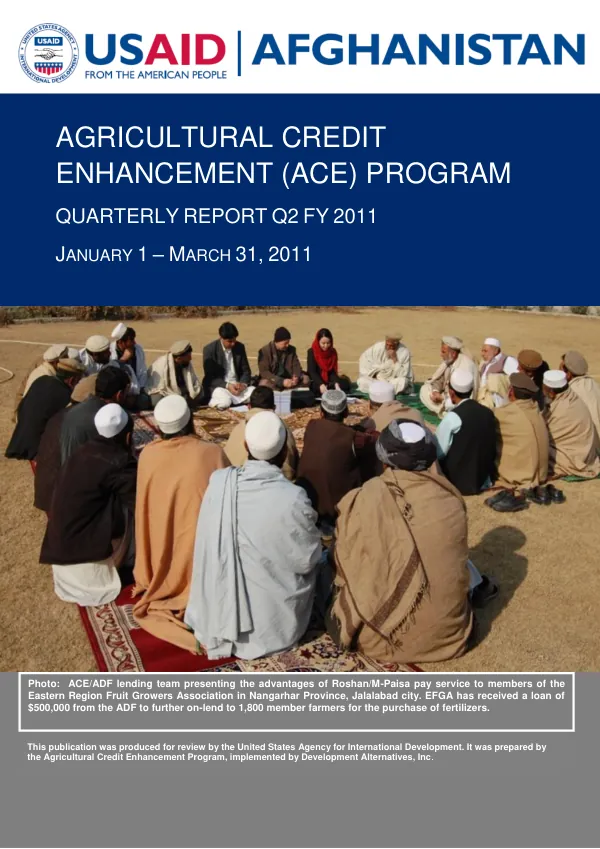
Agricultural Credit Enhancement (ACE) Program Quarterly Report Q2 FY 2011
The Agricultural Credit Enhancement (ACE) Program reached US$16 million in loans approved at the start of the third quarter.
2011 · 28 pages
Sign in to readA free account is required to download.
Abstract
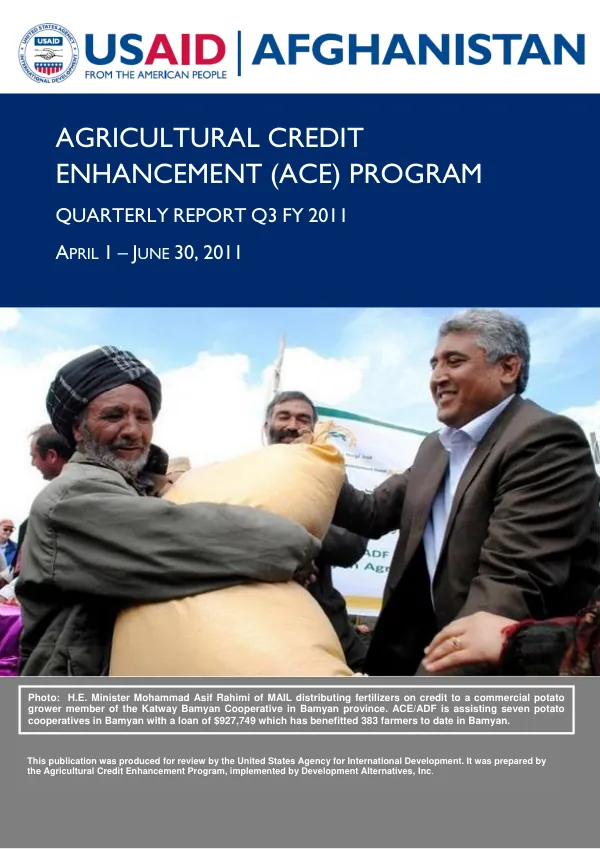
The approvals resulting from the last ADF/MAIL/USAID Credit Committee include a US$4.95 million loan to the Afghanistan National Seed Organization (ANSOR) and a US$100,000 loan to Season Honey, a medium-scale honey processing company located in Jalalabad. The loan to ANSOR will directly reach over 3,000 seed producers and will assist 93 Seed Enterprises, while the loan to Season Honey will enable the company to integrate an additional 300 beekeepers from Kunar, Laghman, Nangarhar, and Nuristan provinces into their supplier network. The quarter was spent on important programmatic activities, including the approval of two additional loans, disbursements of four loans, participation of ADF clients in national and international fairs, and the launching of the Credit Management Unit (CMU) concept. Building upon the experience of Pashtany Bank, CMUs will be established for ANSOR, Bamyan Cooperatives, and The Eastern Fruit Growers Association (EFGA). The reporting period was characterized by close cooperation and joint efforts of the ACE lending, value chain, and market information teams, aiming for high-quality loan packages through thorough technical assessments and the inclusion of market intelligence. The loan pipeline for the next quarter consists of US$10.9 million in encouraging loan prospects, which will be further developed in the following month. Regional lending officers have been aggressively looking for new business opportunities and have continually assisted agribusinesses with the loan application process. The value chain team made an enormous contribution to the program by conducting technical assessments for commodities grown by agribusinesses and farmers' associations applying for ADF loans. Overall, the technical assistance of the value chain team through special studies has informed and influenced investment decisions of the project. The ACE program has achieved several milestones, including the approval of loans worth US$16 million, the launch of a modified version of Murabahah for the procurement of agricultural inputs, and the establishment of Credit Management Units as an innovative tool for risk management when working with non-financial intermediaries. The program has also strengthened its collaboration with the Ministry of Agriculture, the Almond Industry Organization (AAIDO), the Eastern Region Fruit Grower Association (EFGA), and Season Honey Processing and Packaging Company. A second grant for the establishment of a Credit Management Unit has been approved for AAIDO, and the CMU concepts for ANSOR, EFGA, and Bamyan Cooperatives are underway. The ACE program has also supported the participation of AAIDO in the Dubai Gulf Food Exhibition in February and supported the Agricultural Fairs organized in Kabul and Nangarhar province for Farmers' Day 2011. The project is preparing to assist the participation of four ADF clients in the Uzbekistan AgroMinitech Expo, which will take place in May. The Monitoring and Evaluation team has taken the lead to provide non-financial intermediaries with tailor-made forms for loan agreements with farmers, which have been used as the loan proof for direct beneficiaries and constitute the basis of information for further studies, such as baseline and impact assessments. In the next quarter, ACE is planning two public events for the distribution of seeds and fertilizers to members of the Eastern Region Fruit Growers Association in Jalalabad and Bamyan Potato Cooperatives. 438 Potato growers from Bamyan Province will receive an estimated 423 per jerib in seeds and fertilizers on credit, whereas 1,850 orchard farmers in Nangarhar province will receive an estimated $250 worth of fertilizers on credit. The delivery of credit services constitutes the core activity of the ACE project. For this purpose, the project team partners with financial and non-financial institutions that seek innovative models to provide farmers with credit, while managing the risks inherent to a weak institutional environment and security challenges. By the end of March, ACE had $16 million in loans approved by the joint ADF/MAIL/USAID Credit Committee. Four Credit Committee meetings carried out throughout the reporting period approved four new loans, two contact modifications, and rejected the loan proposals for Afghan Finance Corporation (AFC) and Amiri Cultural and Social Foundation. The program faced the need for modifications in two of the loans approved in the previous quarter.