USAID DEC
Agricultural Extension and Technology Adoption for Food Security: Evidence from Uganda
Sign inBRAC INTERNATIONAL
Agricultural Extension and Technology Adoption for Food Security: Evidence from Uganda
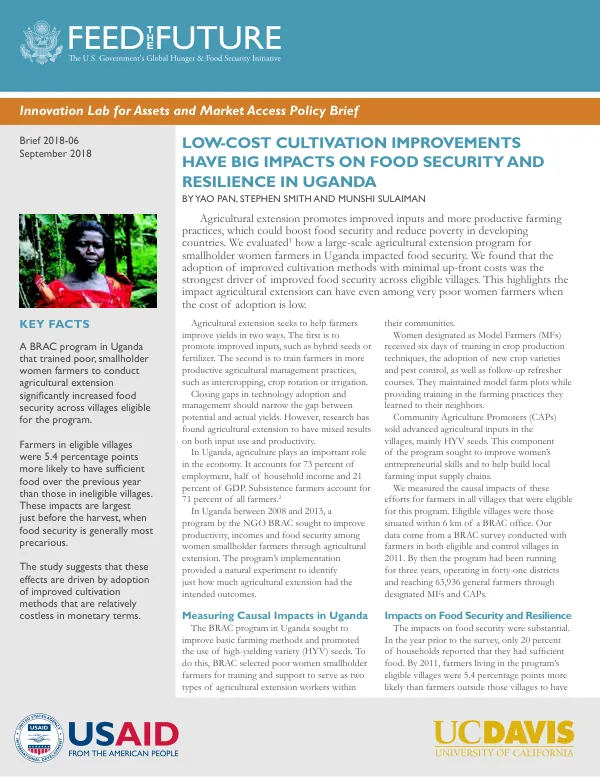
Agricultural extension and technology adoption for food security in Uganda is the focus of a large-scale program designed by the nongovernmental organization (NGO) BRAC.
2018 · 20 pages
Sign in to readA free account is required to download.
Abstract
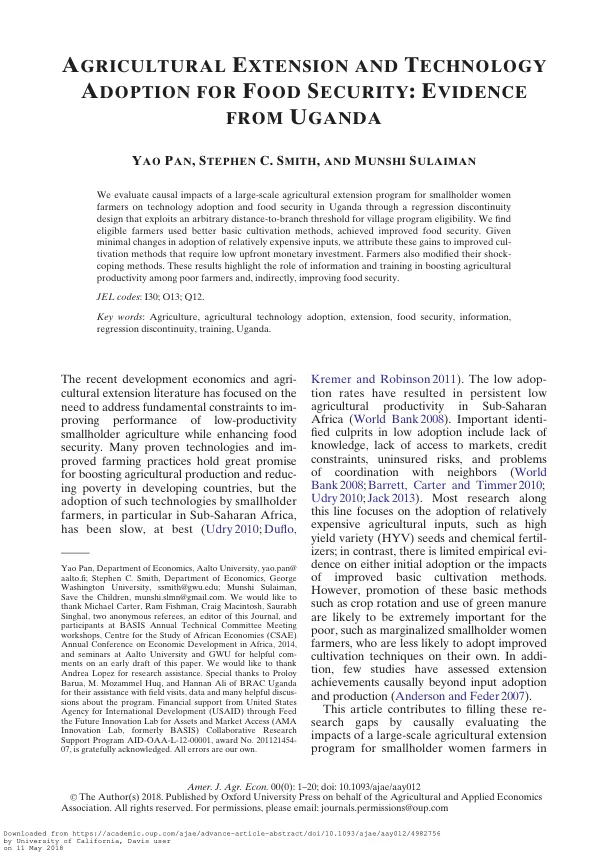
The program features two main components: training and easier access to high-yield variety (HYV) seeds. Eligibility for the program is limited to villages within 6 km of the nearest BRAC branch office, allowing for analysis of the intention-to-treat effects under a regression discontinuity design framework. Using survey data from over 3000 agricultural households near the distance threshold, researchers estimate the effect of program eligibility at the village level on multiple indicators of individual households' food security. The analysis includes possible within-village spillover effects. Detailed inputs usage and farming practices information are reported, providing the potential to separate the effect of improvement in farming methods from input changes in promoting food security. Estimated impacts on food security are substantial. For farmers residing in BRAC coverage area ("eligible") villages, the likelihood of having sufficient food for family needs increased by 5.4 percentage points over the previous year compared with farmers residing in ineligible villages. Per capita household food consumption increased by about 11.6% in the week prior to the survey. Households eligible for the program were 6.2 percentage points less likely to limit consumption varieties and were 9.5 percentage points less likely to skip meals in the month leading up to the survey. The program had no impact on households' likelihood to worry about insufficient food and to consume limited portions of food. However, households eligible for the program were 8.3 percentage points more likely to reduce consumption and 4.9 percentage points less likely to sell assets in the face of covariate shocks, compared with ineligible households. These findings provide additional evidence on improved food security for farmers residing in eligible villages. In terms of mechanisms, the agricultural extension services significantly increase the usage of improved cultivation methods that require low upfront monetary investment. Farmers residing in eligible villages are 9.2 percentage points more likely to use manure (organic fertilizer) and 3 percentage points more likely to irrigate their land compared with those residing in ineligible villages. Being eligible for the program also increases farmers' adoption rate of intercropping and crop rotation by 6 and 8 percentage points, respectively. All these practices have been documented to mitigate soil erosion and increase yields. In contrast, the adoption rate of improved seeds remains statistically unchanged regardless of advocacy in training sessions, improved access, and supply-side subsidy. Seed purchases from BRAC increase by 4.3 percentage points, and BRAC seeds could be of higher quality than that of existing market seeds, which would represent a potential positive program impact. The extension program does not change the adoption rate of other costly agricultural inputs, such as chemical fertilizer and pesticides. Given negligible identified changes in usage of advanced inputs, the findings of improved food security are most likely to be driven by changes in basic farming methods, which are achieved via training and learning.
Related documents