USAID DEC
A Systems Framework for International Development: The Data‐Layered Causal Loop Diagram
Sign inGEORGE WASHINGTON UNIVERSITY CIBER
A Systems Framework for International Development: The Data‐Layered Causal Loop Diagram
The United Nations Sustainable Development Goals (SDGs) are a call to action to end poverty, eliminate hunger, enhance equality, widen access to water, energy, and education, and achieve many other important milestones for humanity.
2021 · 22 pages
Sign in to readA free account is required to download.
Abstract
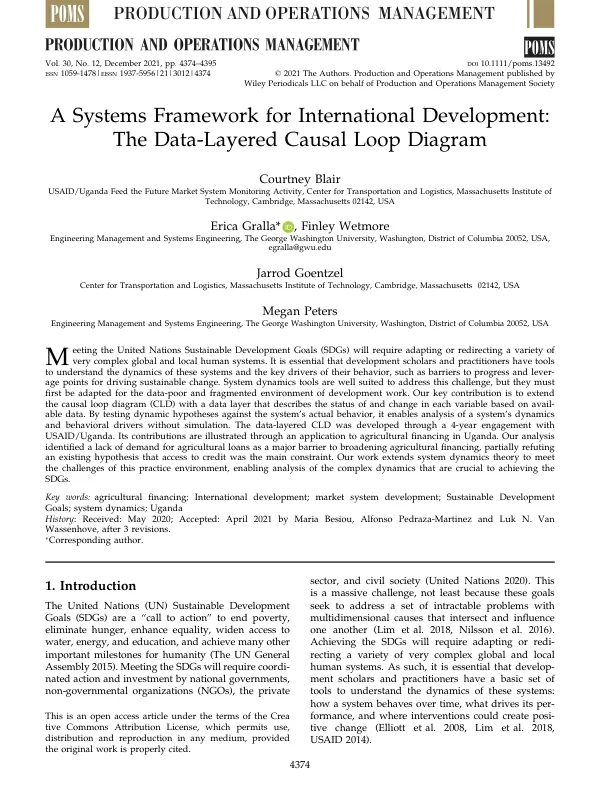
Meeting the SDGs will require coordinated action and investment by national governments, non-governmental organizations (NGOs), the private sector, and civil society. This is a massive challenge, not least because these goals seek to address a set of intractable problems with multidimensional causes that intersect and influence one another. Achieving the SDGs will require adapting or redirecting a variety of very complex global and local human systems. It is essential that development scholars and practitioners have tools to understand the dynamics of these systems and the key drivers of their behavior, such as barriers to progress and leverage points for driving sustainable change. System dynamics tools are well suited to address this challenge, but they must first be adapted for the data-poor and fragmented environment of development work. The system dynamics approach has been widely recognized as a valuable tool for analyzing complex systems, but it has several limitations in the context of development work. Causal loop diagrams (CLDs) provide a broad picture of the system's causal structure, while simulation models reveal how key elements of the structure drive system behavior. However, system dynamics tools must be adapted for use in fragmented and data-poor environments, where limited quantitative and qualitative data are available for the numerous factors that determine development outcomes. To address this challenge, a data-layered causal loop diagram (CLD) has been developed. This framework extends the system dynamics approach by adding a data layer to each variable in the diagram, describing its status and change over time. The data-layered CLD enables a characterization of a system's dynamic behavior and a limited test of hypothesized explanations for its behavior by comparing actual behavior against expectations. This framework mitigates some of the drawbacks of relying on CLDs alone and avoids simulating based on broad assumptions in a fragmented and data-poor environment. The data-layered CLD was developed through a 4-year engagement with the United States Agency for International Development (USAID) in Uganda. The framework was evolved through several studies, which involved extensive practitioner engagement and the assembly and analysis of different data sources to assess the status of the system. The resulting data-layered CLD was used to understand the dynamics of the system over time and identify barriers to change and leverage points for change. One of the main applications of the data-layered CLD is in the analysis of agricultural financing in Uganda. Access to financing for improved agricultural inputs, such as higher quality seeds, is widely considered a potential enabler of increased agricultural production and therefore food security and economic growth in sub-Saharan Africa. A data-layered CLD was developed through extensive stakeholder engagement, assembled and analyzed different data sources to assess the status of the system, and analyzed the resulting data-layered CLD to understand the dynamics over time. The analysis found that one of the main barriers to broader agricultural financing is a lack of demand for loans among rural Ugandans, an insight that seems to have been under-emphasized or missed by the practice and scholarly communities. The data-layered CLD has several practical contributions to international development. It provides a framework for monitoring a system's dynamic behavior, identifying barriers to change, and identifying leverage points for change. The framework was developed through extensive practitioner engagement, which enabled the adaptation of the system dynamics approach for practical application to development policy guidance. The data-layered CLD has been applied in a variety of development contexts, including health, agriculture, and democracy and governance.